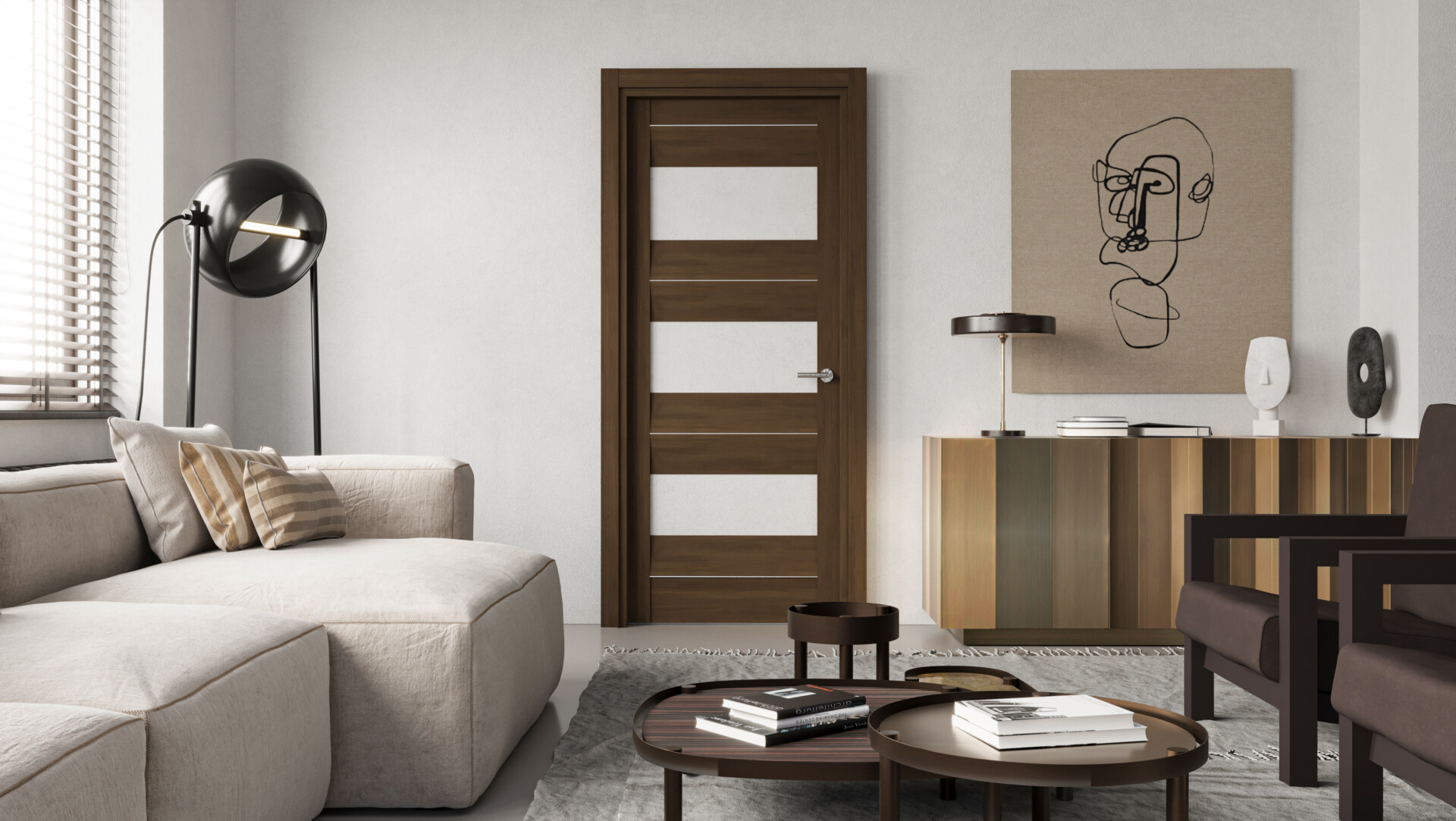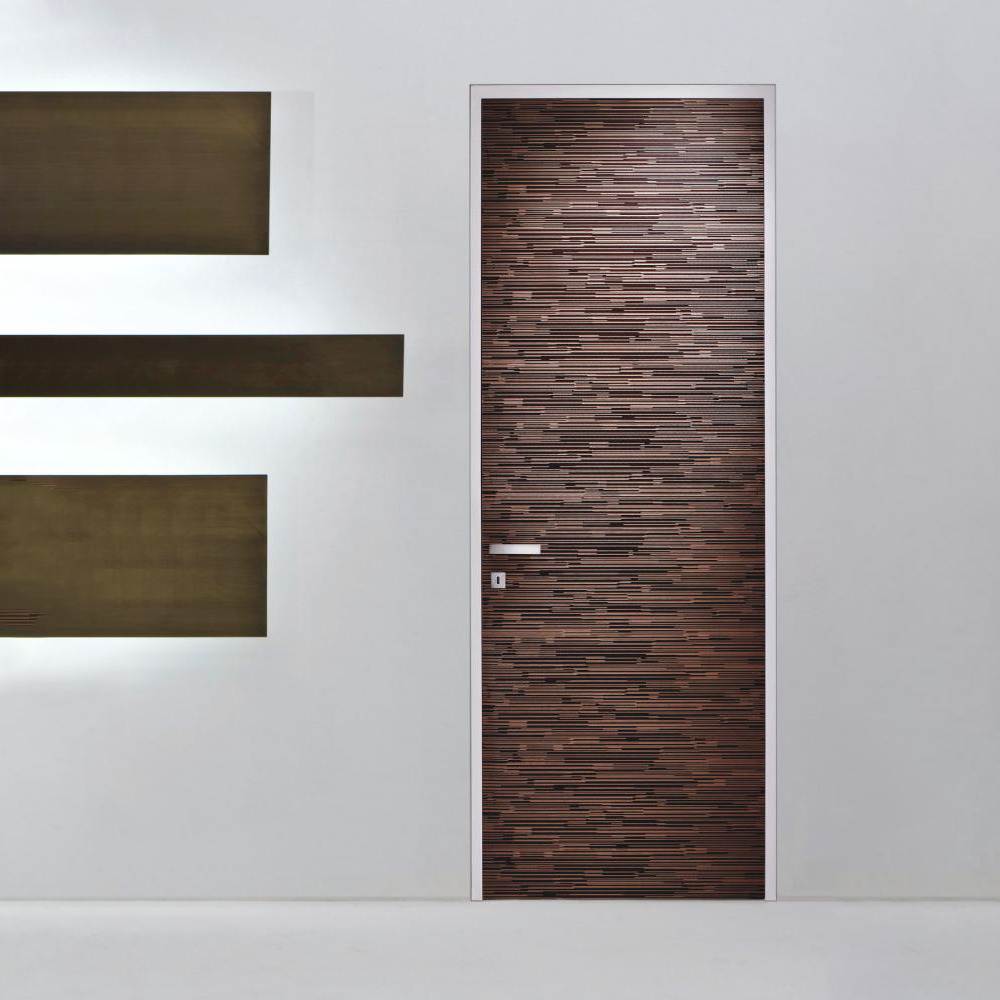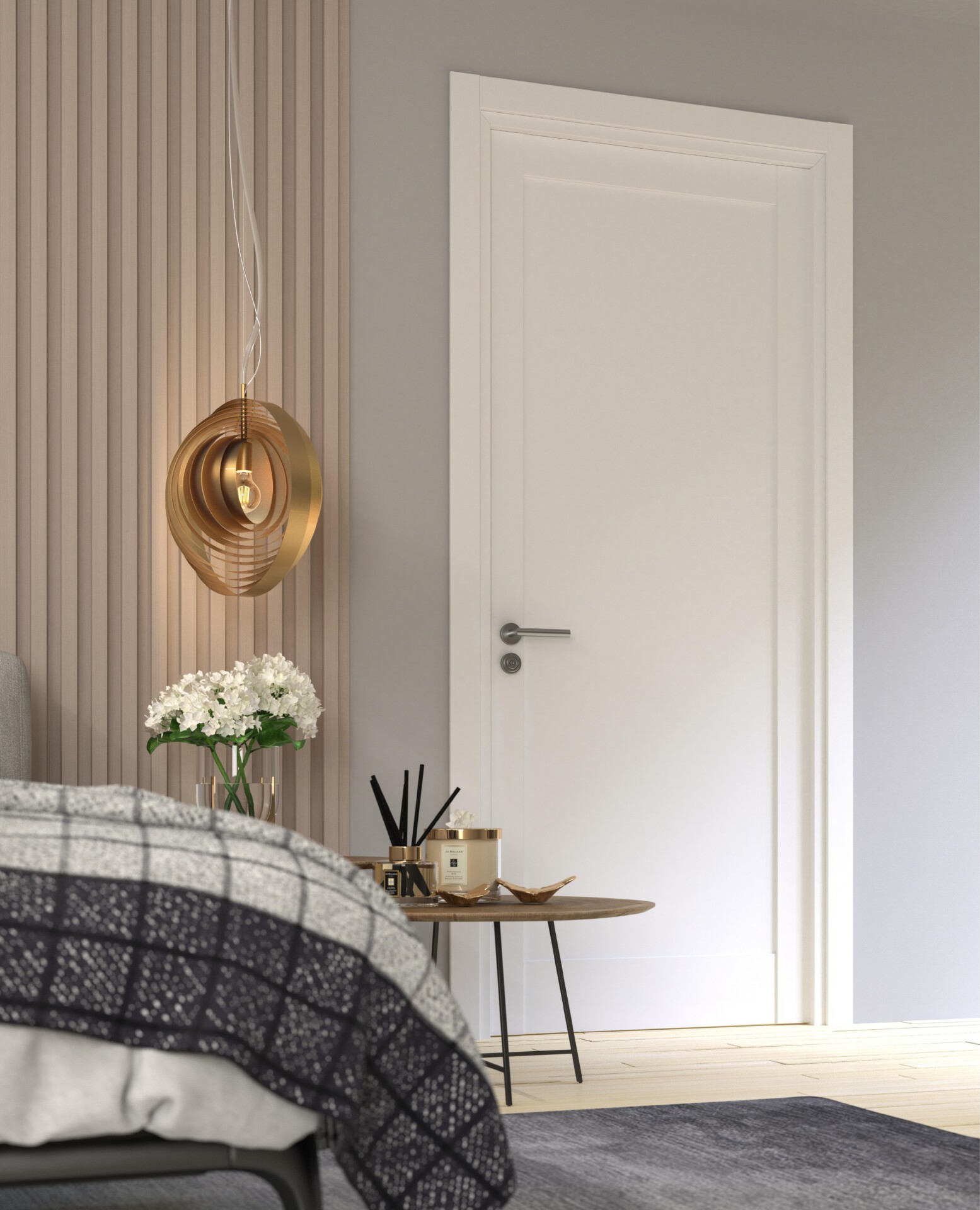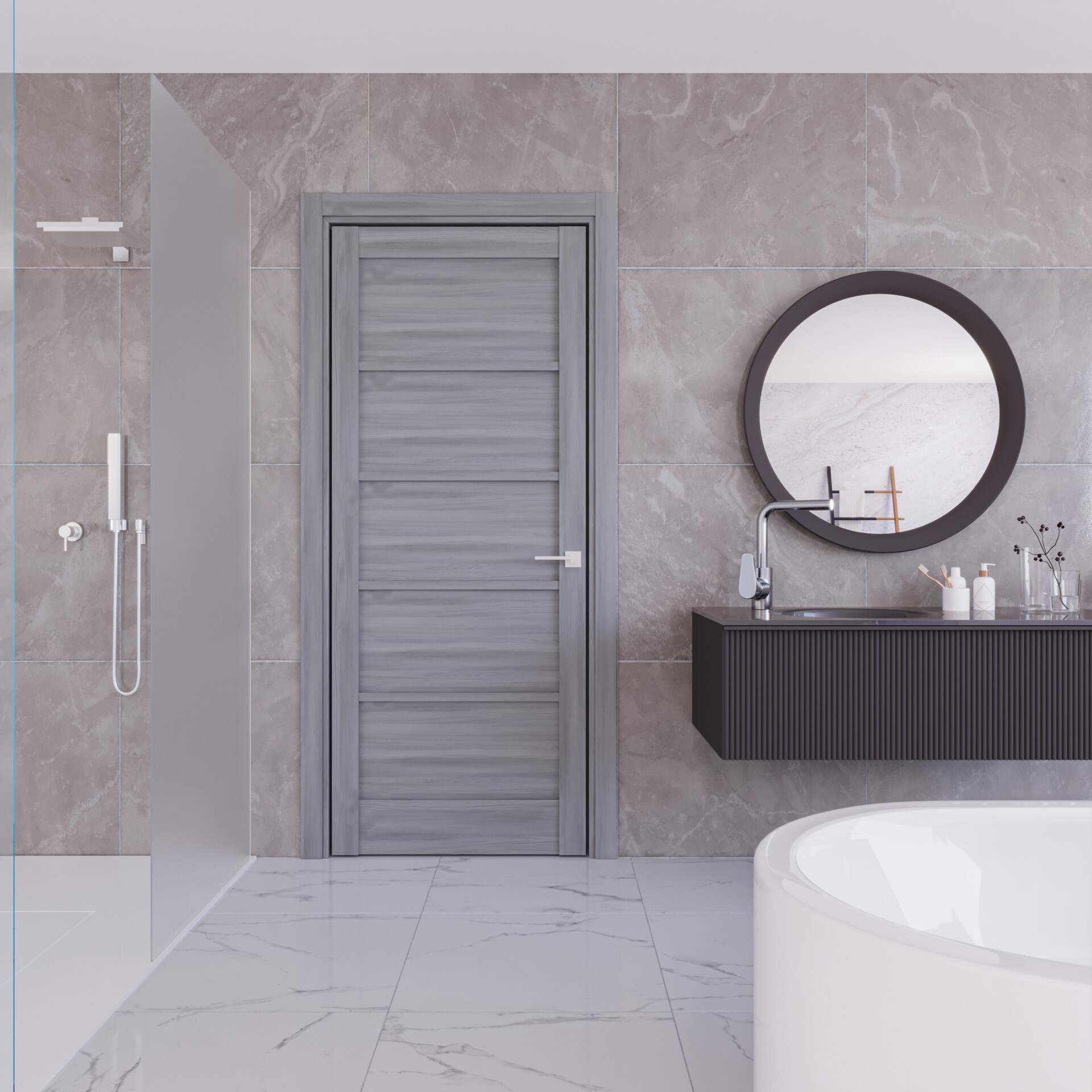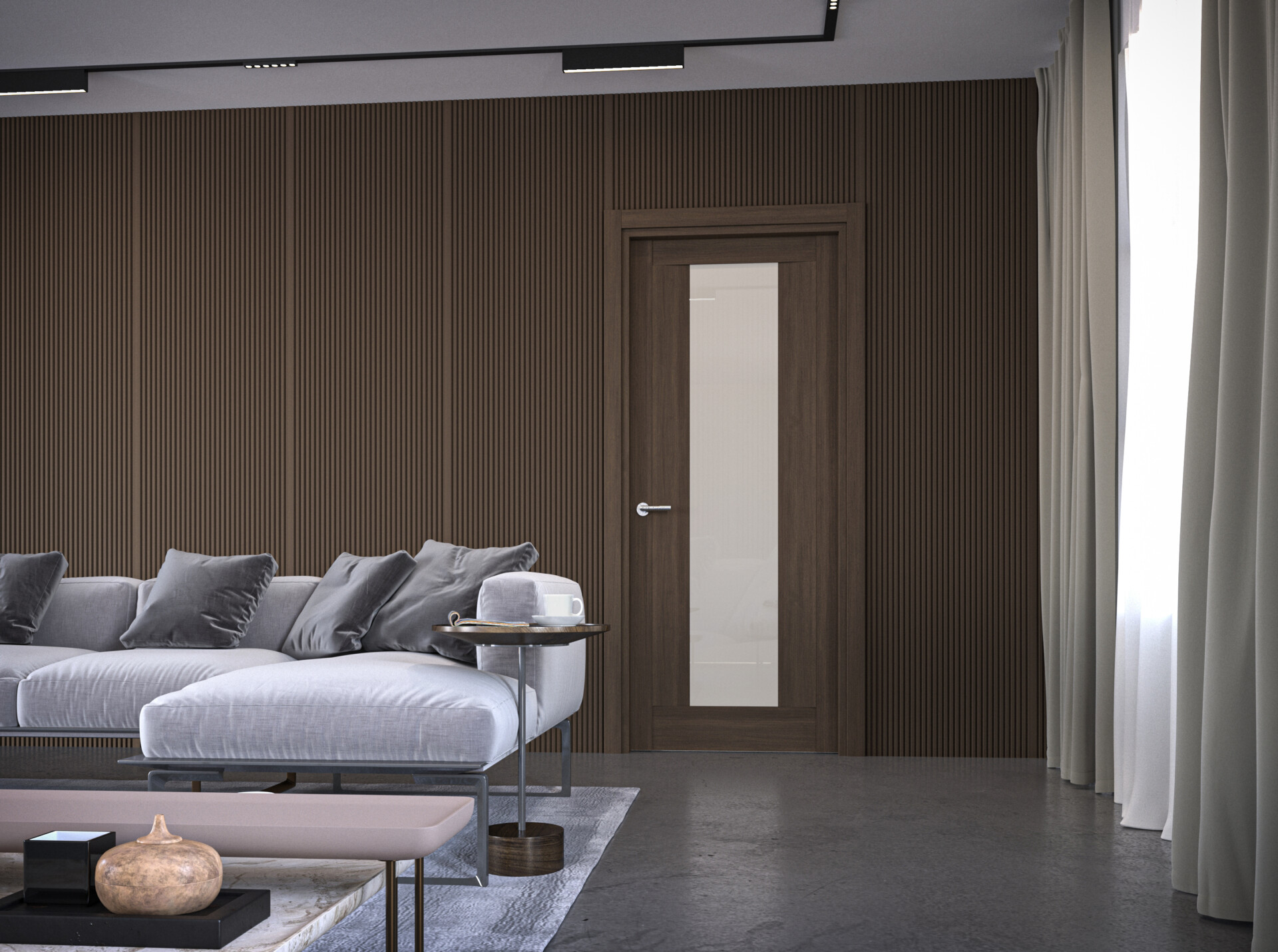
Solid wood is not automatically the highest-performing choice for a luxury interior door; many Italian manufacturers use engineered cores because controlled construction can remain straighter, accommodate larger formats, and support real wood veneers or lacquered finishes more consistently. This guide explains what solid wood, engineered solid-core, tubular-core, and hollow-core doors contain so you can choose the right construction for your project.
Solid wood is not the opposite of luxury engineered construction
No, an engineered wood door is not automatically fake, hollow, or lower quality. The word “engineered” explains how the door is constructed, not how well it is made.
Several terms are frequently used as though they mean the same thing, but each describes a different characteristic:
- Solid wood describes a door made primarily from solid timber components.
- Engineered construction describes a door made by combining selected materials to control weight, stability, surface quality, or structural behavior.
- Solid core means that the internal construction is relatively dense, although the exact core material can vary.
- Tubular core describes an engineered core containing organized internal channels.
- Hollow core usually refers to a lightweight internal framework, often using a honeycomb structure beneath thin faces.
- Veneer, lacquer, and laminate describe the visible surface rather than the entire internal construction.
A door can therefore have a carefully engineered core and still present an authentic oak or walnut surface. A lacquered door can use a stable MDF-based surface without looking inexpensive. Conversely, a door marketed broadly as “wood” may contain only a thin decorative surface over a basic lightweight core.
Engineered is a category, not a quality grade. A low-cost honeycomb door and a precision-manufactured architectural door may both be described as engineered, but their cores, faces, perimeter structures, hardware, tolerances, and intended applications can be completely different.
This distinction is especially important when comparing Italian door systems. ITALdoors does not approach a door as an isolated slab. The leaf, frame, casing, hinges, lock, handle, finish, opening type, and installation conditions must work together as one coordinated architectural system.
Solid wood, solid-core, tubular-core, and hollow-core doors compared
The most useful comparison begins with a clear definition of each construction type. Broad labels such as “real wood” or “engineered wood” do not provide enough information to evaluate performance.
Solid wood doors
A solid wood door is normally assembled from solid timber components rather than cut from one enormous piece of lumber. Traditional examples often use stile-and-rail construction, in which vertical stiles and horizontal rails frame one or more solid or raised panels.
Solid timber is valued for its natural grain, repairability, carving potential, traditional joinery, and ability to develop character over time. It is particularly suitable for restoration work, classical interiors, heavily detailed doors, and projects where the material itself is part of the architectural concept.
However, natural timber absorbs and releases moisture as surrounding conditions change. Species selection, moisture content, fabrication, finishing, storage, installation, and interior climate therefore remain important parts of the specification.
Engineered solid-core doors
An engineered solid-core door uses a dense internal structure rather than relying entirely on full-thickness solid timber. Depending on the manufacturer and product, the core may include MDF, particleboard, stave lumber, wood blocks, or a proprietary composite construction.
The visible faces may then be finished with:
- Real wood veneer
- Factory-applied lacquer
- Architectural laminate
- Another decorative or protective surface
The Architectural Woodwork Institute recognizes several types of solid-core construction, including particleboard, stave, and lined wood-block cores. This is why the phrase “solid core” should always be followed by a more specific question: What is the core actually made from?
Engineered solid-core doors are frequently chosen when a project requires a substantial feel, consistent flatness, controlled surface quality, and better acoustic potential than a basic hollow-core door. Final sound performance still depends on the entire assembly, including gaps, seals, frame, hardware, and installation.
Tubular-core doors
A tubular-core door contains a structured internal material with organized channels. Those channels reduce unnecessary mass while preserving more material and internal support than a basic honeycomb core.
This approach can provide a useful balance between:
- Structural rigidity
- Door-leaf weight
- Hardware loading
- Smooth operation
- Material efficiency
A tubular core should not automatically be grouped with inexpensive hollow-core construction. It can be used deliberately in architectural doors where the manufacturer wants predictable geometry without the full weight of a dense solid core.
Performance varies by core density, perimeter construction, surface material, dimensions, and hardware. The exact composition should therefore be confirmed from the documentation for the selected model rather than assumed from the general term.
Hollow-core doors
A basic hollow-core door usually has thin outer faces supported by a lightweight honeycomb or similar internal framework. This construction keeps the door light and economical, making it suitable for cost-sensitive interior openings with limited performance demands.
Its limitations commonly include:
- A lighter and less substantial operating feel
- Lower impact resistance
- Reduced hardware-holding capacity
- More limited acoustic separation
- Fewer options for modification or trimming
- Less suitability for large architectural formats
A hollow-core door can still be appropriate for secondary rooms, temporary spaces, or developments where initial cost is the dominant concern. It is simply serving a different purpose from a dense or architecturally engineered door.
| Decision factor | Solid wood | Engineered solid core | Tubular engineered core | Basic hollow core |
|---|---|---|---|---|
| Basic construction | Solid timber components | Dense manufactured core | Structured core with internal channels | Lightweight honeycomb framework |
| Surface options | Natural wood, stain, or paint | Veneer, lacquer, or laminate | Veneer, lacquer, or laminate | Thin molded or decorative facing |
| Dimensional stability | Depends strongly on species, fabrication, and climate | Generally predictable when properly engineered | Designed to balance rigidity and weight | May remain flat but offers limited structural substance |
| Door-leaf weight | Usually high | High to moderately high | Usually moderate | Low |
| Acoustic potential | Good, depending on the complete assembly | Often strong, subject to assembly design and testing | Varies by core and system | Usually limited |
| Large-format suitability | Requires careful engineering | Often well suited | Potentially well suited | Generally not the preferred architectural option |
| Typical application | Traditional, heritage, carved, or material-led projects | Residential and commercial interiors requiring stability | Architectural interiors requiring balanced weight | Budget-sensitive interior openings |

Why luxury Italian door manufacturers often use engineered construction
Luxury manufacturers use engineered construction because the door must continue to operate correctly after the initial visual impression. Stability, alignment, hardware compatibility, surface consistency, and appropriate weight can matter more than maximizing the amount of solid timber inside the leaf.
Dimensional stability protects alignment
Natural wood changes as it absorbs or releases moisture. When material selection, fabrication, storage, finishing, installation, or climate control is inadequate, those changes can contribute to swelling, shrinkage, checking, splitting, bowing, or twisting.
The practical concern is not merely whether the wood moves. It is whether that movement affects:
- The gap between the door and frame
- Magnetic lock engagement
- Concealed hinge alignment
- Clearance above the floor
- Contact with casing or wall surfaces
- Smooth movement through a pocket or sliding track
- Visual continuity across repeated openings
A carefully engineered core distributes and controls material movement rather than relying on one mass of natural timber. That does not make the door immune to moisture or poor installation, but it can make its behavior more predictable under the conditions for which it was designed.
This becomes especially relevant in warm coastal regions. ITALdoors has addressed the relationship between core stability, finish protection, and indoor climate in its guide to how Italian doors handle South Florida humidity.
Engineered cores support cleaner proportions
Modern interior architecture frequently requires more than a conventional door inside a standard opening. Architects and designers may specify:
- Tall or oversized leaves
- Wide flat surfaces
- Flush-to-wall systems
- Frameless openings
- Concealed hinges
- Pocket and sliding configurations
- Doors aligned with wall paneling
- Repeated openings along long corridors
These applications make even small deviations easier to see. A slight bow that may be visually tolerable on a traditional paneled door can become obvious on a tall, flat walnut-veneered leaf aligned with adjacent millwork.
A pocket door creates another set of demands. The leaf must move through a controlled cavity without rubbing, twisting, or falling out of alignment with the track. A sliding or concealed system therefore depends on more than the visible finish; it requires predictable dimensions and coordination between the leaf, frame, track, hardware, wall construction, and finished floor.
More weight is not always better
A substantial door can feel reassuring, but the heaviest possible door is not automatically the best-engineered door. Excess mass affects hinges, frames, tracks, pivots, installation, and daily operation.
A well-designed engineered core may reduce unnecessary weight while preserving the rigidity required for the selected dimensions. Depending on the product and configuration, this can support:
- More manageable loads on hinges and frames
- Smoother daily operation
- Better coordination with concealed hardware
- Greater flexibility for tall or wide panels
- Easier installation and adjustment
This does not mean every engineered door is light. Dense solid-core doors can be extremely heavy, which is why leaf weight and compatible hardware should be confirmed for the specific model.
Stable substrates help finishes remain consistent
Real wood veneer, lacquer, and laminate depend on the substrate beneath them. A high-quality face cannot compensate for a door leaf that bows, develops uneven edges, or moves out of alignment.
A stable substrate helps preserve:
- Flat visual planes
- Crisp corners and edges
- Consistent reveals
- Accurate junctions with the frame
- Balanced veneer presentation
- Smooth lacquered surfaces
Readers deciding between visible wood grain and a smooth contemporary surface can also review how factory-finished lacquered Italian doors combine controlled surfaces with engineered construction.
ITALdoors describes its interior doors primarily as using pine and MDF construction. Certain panel doors may use a pine surround with an XPS core to support panel stability and sound reduction under appropriate interior conditions. Depending on the selected program, visible surfaces may include veneer, lacquer, or laminate.
The exact core, perimeter, face material, approved dimensions, and compatible configuration should always be confirmed for the selected model. One construction description should not be applied automatically to every ITALdoors door.
What luxury Italian brands actually use
There is no single core construction used by every luxury Italian door manufacturer. The appropriate build depends on what the door must do, how large it is, which finish it carries, and how it integrates with the surrounding architecture.
A manufacturer may choose among:
- Engineered timber or block cores
- Dense MDF or particleboard cores
- Stave or wood-block construction
- Tubular particleboard cores
- Structural timber surrounds with engineered infill
- Real wood veneers over stable substrates
- Factory-lacquered MDF surfaces
- Architectural laminates over engineered panels
The final selection can be affected by the door’s swing, pocket, sliding, pivot, concealed, or frameless configuration. Hardware, interior or exterior exposure, fire or impact requirements, acoustic goals, opening dimensions, and project tolerances may also change the appropriate construction.
At the ITALdoors Miami showroom, homeowners and project professionals can inspect available finishes, compare system components, and discuss how the leaf, frame, casing, hinges, magnetic lock, handle, and opening configuration are intended to work together. Product-specific construction should be confirmed before the door is specified or ordered.
Florida humidity exposes the difference between appearance and construction
For Miami, coastal, and other humid interiors, a properly selected engineered door is often the more predictable choice because dimensional stability matters as much as the visible wood surface. However, no interior door should be treated as waterproof or suitable for direct exterior exposure unless it was specifically designed and documented for that use.
Air-conditioned properties can still contain different moisture conditions. Bathrooms, laundry rooms, entry-adjacent areas, corridors connected to exterior doors, garages, and frequently opened spaces may not behave like a consistently conditioned bedroom or office.
A protective finish helps limit moisture interaction with the surface, but finish alone cannot correct:
- An unsuitable core
- Unsealed or damaged edges
- Incorrect storage before installation
- Poor opening preparation
- Incompatible hardware
- Direct water exposure
- An uncontrolled leak
- Improper use of an interior product outdoors
For a deeper climate-specific explanation, review why engineered Italian doors can be a practical choice for South Florida homes. Projects centered on a smooth painted appearance should also consider the maintenance and finish factors discussed in the guide to lacquered Italian doors for humid interiors.
Local product-selection, measurement, ordering, logistics, and installation coordination are especially valuable in humid regions because successful performance depends on the complete system and actual site conditions.
When solid wood doors are still worth considering
Solid wood doors are worth considering when authentic timber construction is itself an important design or preservation objective. They are not obsolete, and a well-made solid timber door can perform for many years in an appropriate environment.
Solid wood may be the right choice for:
- Historic restoration
- Traditional stile-and-rail craftsmanship
- Carved or deeply profiled details
- Interiors designed around natural variation and patina
- Projects where visible solid edges are part of the concept
- Owners prepared for suitable climate control and maintenance
- Standard-size openings where the construction has been properly engineered
The tradeoff is that solid timber carries natural movement, greater material use, potentially higher weight, and more demanding fabrication and finishing requirements. These characteristics are not necessarily disadvantages when they are understood and intentionally specified.
Exterior doors require a separate decision process. Neither a solid wood interior door nor an engineered interior door should be moved outdoors simply because its surface appears substantial.
An exterior door must be evaluated as a complete assembly, including:
- Direct weather exposure
- Frame and threshold design
- Perimeter sealing
- Security construction
- Thermal requirements
- Water and air management
- Applicable fire, impact, or regional approvals
- Manufacturer installation documentation
Solid wood can be a valuable investment when the project genuinely calls for solid timber craftsmanship. It is not automatically the stronger investment when the priorities are oversized dimensions, precise alignment, consistent factory finishes, controlled weight, or performance in variable humidity.
Choose the construction first, then choose the wood species or finish
Yes, an engineered door can have a real oak or walnut surface. In many architectural doors, the core provides structural performance while the veneer provides the visible grain, tone, and material character.
This means construction and wood species should be treated as two related but separate decisions.
Begin with the functional requirements:
- Is the opening interior or exterior?
- Is the leaf standard size, tall, wide, or otherwise custom?
- Will it swing, slide, pivot, disappear into a pocket, or align flush with the wall?
- Is the space consistently temperature- and humidity-controlled?
- How much privacy or acoustic separation is expected?
- How frequently will the door be used?
- What weight can the hinges, track, pivot, and frame support?
- Are fire, impact, accessibility, or other documented requirements involved?
- When must the wall, frame, floor, and hardware be coordinated?
- Is the design repeated across multiple rooms or units?
- What ordering and installation timeline must the project follow?
Once the correct core and door system have been identified, select the visible material.
Oak generally creates a lighter and more architectural appearance, although its exact tone and grain depend on the species, veneer cut, stain, and finish. The guide to oak interior door styles and design applications explains how oak works across contemporary and transitional interiors.
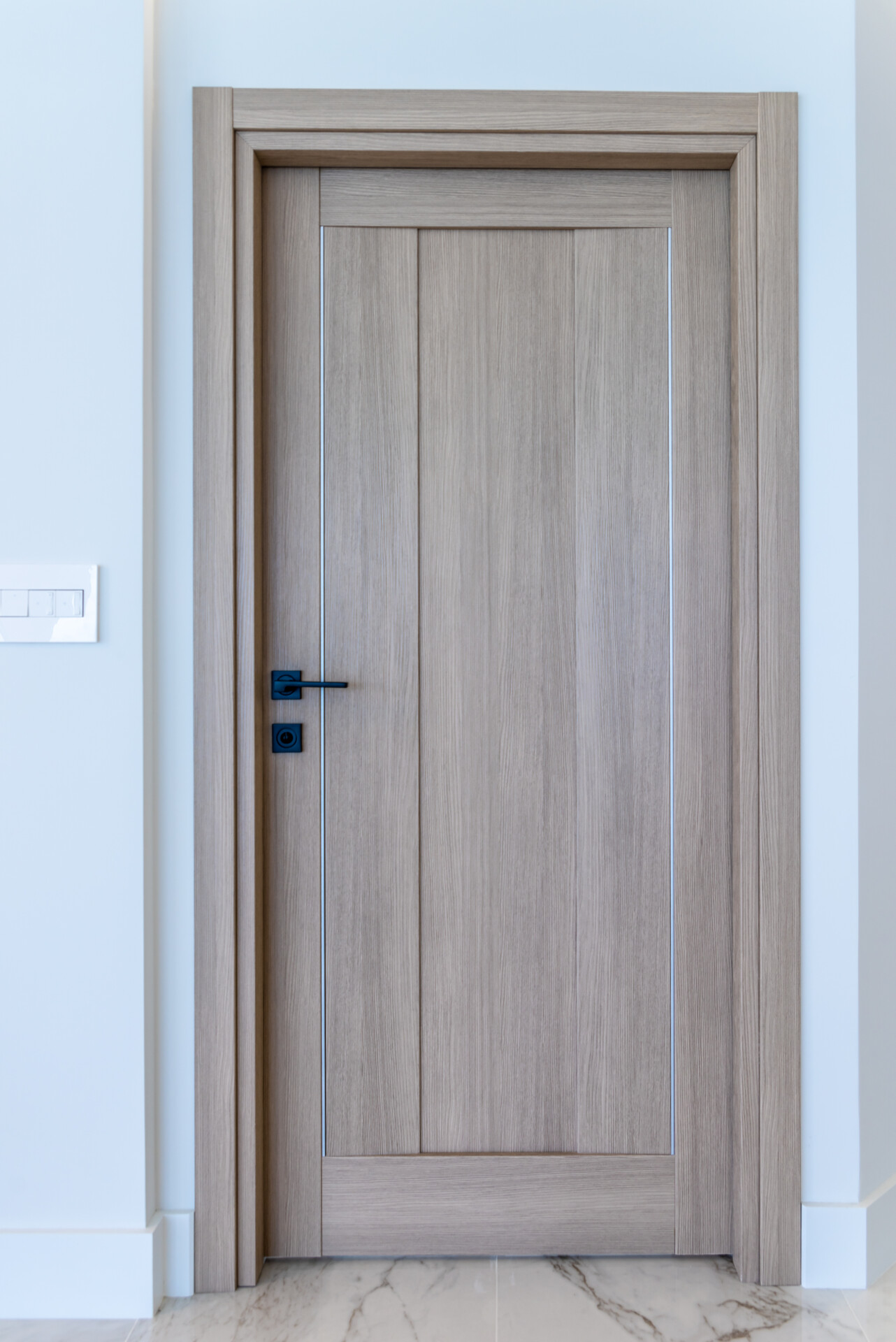
Walnut provides deeper color, stronger contrast, and a more pronounced grain pattern. Designers comparing warm wood surfaces can explore walnut interior doors, grain characteristics, and project suitability.
Lacquer creates a smoother and more controlled surface, while laminate can provide consistent color or texture across repeated openings. Special-order veneer, lacquer, or laminate options may be available depending on the chosen ITALdoors program and project requirements.
For real wood veneers, confirm the species, veneer cut, matching method, direction, edge treatment, finish, and current availability. A general description such as “walnut door” does not reveal whether the face is solid timber, natural veneer, reconstructed veneer, laminate, or another decorative surface.
ITALdoors can help coordinate the visible finish with the leaf, frame, casing, concealed hinges, magnetic lock, handle, and selected opening configuration. For qualifying models, a coordinated package reduces the risk of choosing attractive components that do not work together technically.
ITALdoors helps homeowners, architects, interior designers, builders, contractors, and developers compare Italian-made door systems according to the opening, configuration, finish, hardware, site conditions, and project schedule. Visit the Miami showroom or contact the ITALdoors team to review available materials, selected in-stock options, special-order solutions, and coordinated packages that may include the slab, frame, casing, concealed hinges, magnetic lock, and handle.
Frequently asked questions about Solid Wood vs. Engineered Doors
Are solid wood doors worth it?
They can be worth the investment for restoration, traditional craftsmanship, carved details, natural patina, and projects that specifically require solid timber construction. They are not automatically better for oversized modern doors, humid interiors, minimal-maintenance projects, or flush architectural systems.
Do engineered wood doors look cheap?
Not when the door uses a properly designed core and a well-executed surface such as real wood veneer, factory lacquer, or architectural laminate. A cheap appearance is more often caused by weak surface materials, visible seams, inconsistent patterns, poor edge treatment, basic hardware, or imprecise installation.
Is an engineered wood door the same as a hollow-core door?
No. Engineered wood is a broad construction category. It can include dense solid cores, stave cores, tubular cores, structural timber surrounds, composite panels, or lightweight honeycomb systems. The exact internal construction must be identified.
What is a tubular-core door?
A tubular-core door uses an engineered internal structure with organized channels. The channels reduce unnecessary mass while retaining more internal material and support than a basic honeycomb core. Its performance depends on the density, perimeter, faces, dimensions, hardware, and complete system.
Which blocks more sound: solid wood or engineered doors?
Neither material label guarantees better sound control. Acoustic performance depends on the door’s mass, core density, perimeter gaps, seals, frame construction, threshold conditions, hardware, and installation. Use a tested complete-assembly rating when a project has a specific acoustic requirement.
Do engineered doors warp?
Any door can develop problems if it is poorly manufactured, stored incorrectly, installed in an unsuitable opening, or exposed beyond its intended conditions. A properly designed engineered door is intended to control dimensional movement more predictably, but it still requires correct storage, installation, and interior environmental conditions.
Can an engineered door have a real oak or walnut surface?
Yes. A real wood veneer can be applied over an engineered substrate, allowing oak or walnut to provide the visible appearance while the core provides dimensional stability and structural support. Confirm the exact veneer, matching method, finish, and edge treatment for the selected door.