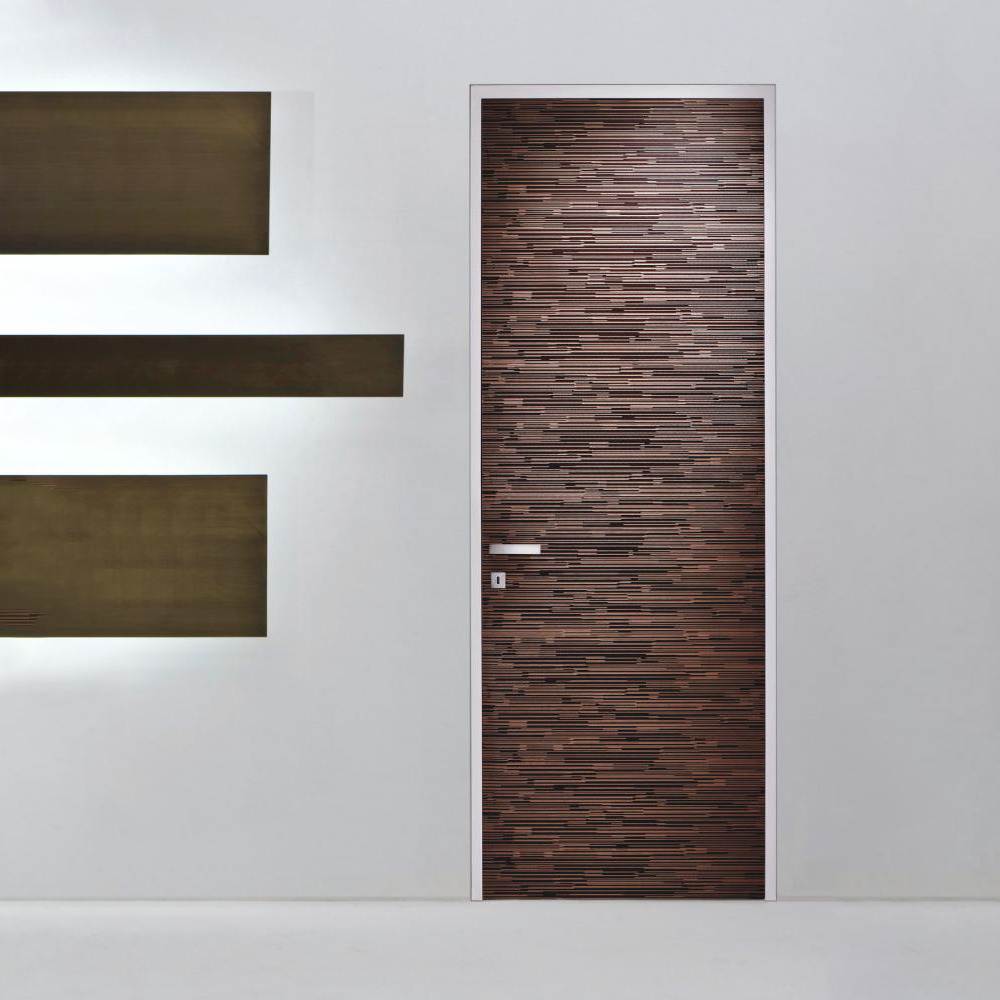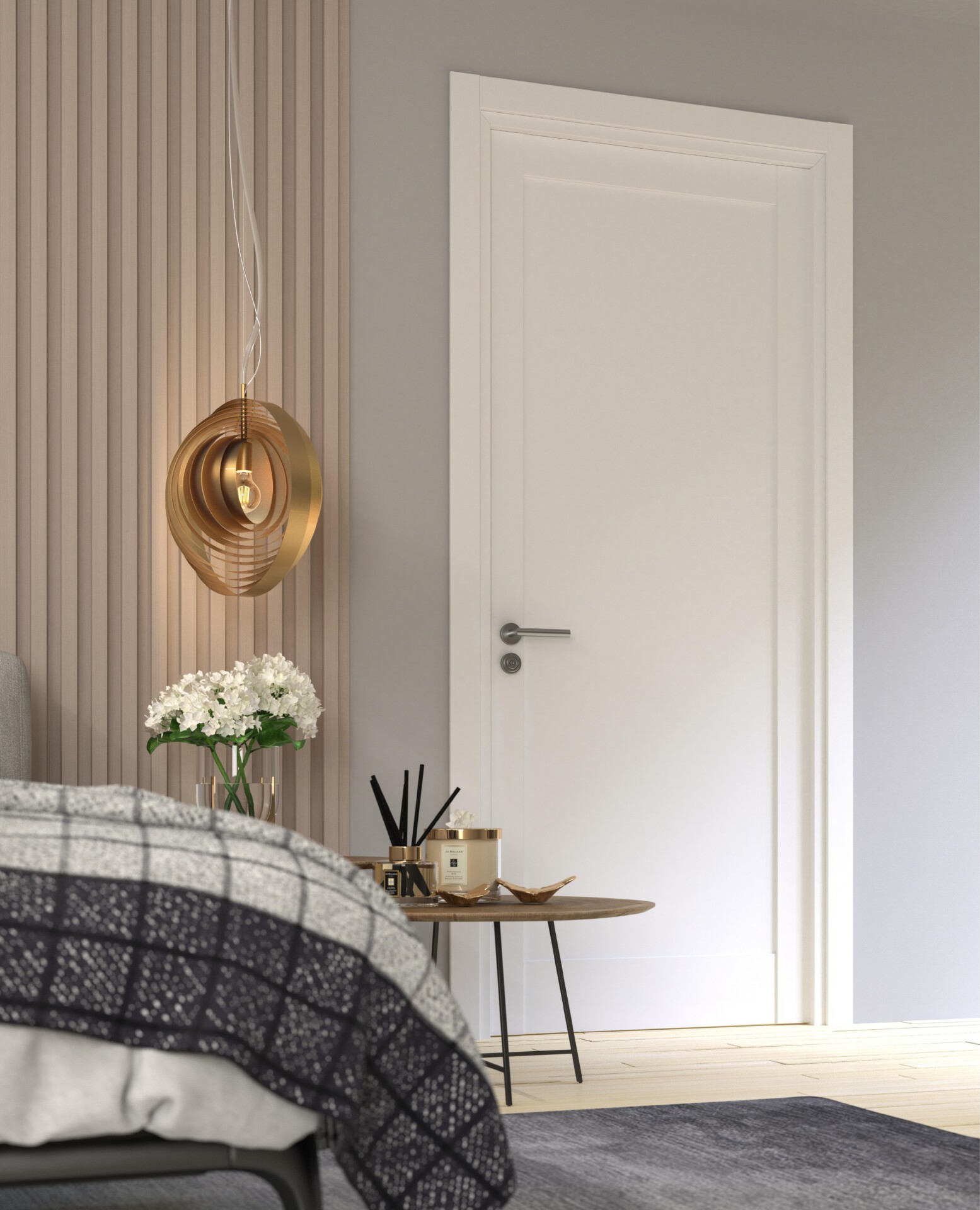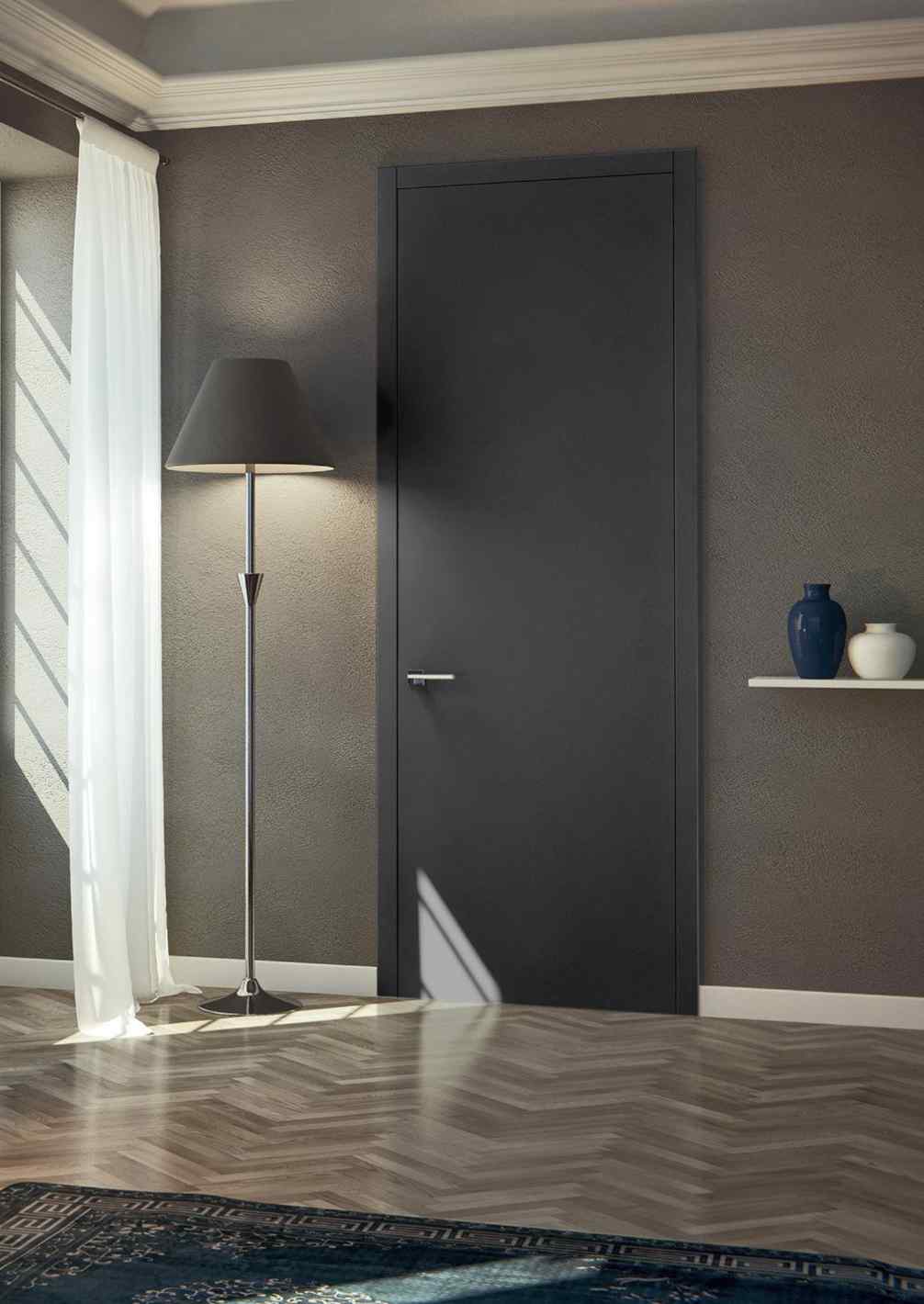
White doors with black frames work because the light door surface keeps an interior open and bright, while the dark perimeter turns the opening into a deliberate architectural feature. Unlike an either-or comparison between black and white doors, this guide explains how to combine both colors, coordinate the surrounding details, and avoid specification mistakes that can leave the result looking unfinished.
Why white doors with black frames work so well
A black door frame around a white door creates contrast without giving the entire opening the visual weight of a fully black door. The combination can work in modern, transitional, industrial, Scandinavian, and warm contemporary interiors, provided that the frame, hardware, wall colors, and nearby finishes are coordinated as one composition.
The black perimeter makes the opening part of the architecture
A white door surrounded by white trim tends to blend into the wall. That can be desirable in soft, traditional, or visually quiet rooms, but it does little to define the opening.
A black frame produces the opposite effect. It creates a clear boundary around the door and makes the opening feel like an intentional architectural element rather than a necessary break in the wall.
This becomes especially effective in hallways containing several aligned doors. Repeated black outlines establish rhythm, guide the eye through the space, and visually organize openings that might otherwise look disconnected.
The frame can also connect the door system with other dark elements, including:
- Black window frames
- Metal stair railings
- Lighting tracks and fixtures
- Cabinet hardware
- Open shelving
- Plumbing fixtures
- Furniture legs
- Decorative steel details
The black element does not need to appear everywhere. One or two repeated connections are often enough to make the frame feel intentional.
The white door keeps the room visually lighter
A white slab reflects more available light than a black one and usually has less visual weight when the door is closed. This can be useful in bedrooms, narrow hallways, apartments, and interiors where a fully black door would become too dominant.
The white surface can connect naturally with light walls, ceilings, cabinetry, and other millwork, while the dark frame provides definition at the perimeter. It is a practical middle ground for homeowners and designers who like the structure created by black doors but do not want every opening to become a large dark rectangle.
Readers still deciding between single-color alternatives can compare the broader design effects in ITALdoors’ guide to choosing between black and white interior doors. The combination discussed here serves a different purpose: it uses white and black together rather than treating them as competing choices.
Homeowners attracted to dark detailing but uncertain about an entirely black slab may also find useful context in the ITALdoors analysis of whether black interior doors are still trending in 2026.
| Configuration | Visual effect | Best suited to |
|---|---|---|
| White door and white frame | Quiet, soft, and integrated | Small rooms, traditional interiors, and low-contrast palettes |
| Black door and black frame | Strong, dramatic, and visually dominant | Large rooms, bold interiors, and statement corridors |
| White door and black frame | Light surface with a defined architectural edge | Modern, transitional, and graphic interiors |

First, decide what “black door frame” actually means
A black frame can refer to several different components. Before requesting a quote, approving drawings, or instructing a painter, clarify exactly which surfaces should be black.
Using the terms frame, jamb, casing, trim, and reveal interchangeably can create different expectations among the homeowner, architect, supplier, and installer.
Black casing or visible trim
The casing is the decorative molding installed around the opening where the door frame meets the wall. It conceals the joint and creates a finished border.
When homeowners describe white doors with black trim, they are often referring only to black casing. This is usually the most accessible version during a renovation because existing casing can sometimes be refinished or replaced without changing the complete door assembly.
The effect is primarily front-facing. When the door is closed and viewed straight on, the black casing creates a clear outline. From an angle or while the door is open, however, the jamb may still be visible in another color.
Black jamb and black casing
The jamb lines the sides and top of the opening and forms the surface against which the door closes. Making both the jamb and casing black creates a more complete dark perimeter.
This treatment usually looks more deliberate because the black finish remains visible when the door is open or viewed from the side. It avoids the abrupt transition that can occur when the casing is black but the inside of the opening remains white.
The door stop and other visible frame surfaces must also be included in the finish plan. Painting only the front trim while ignoring the deeper parts of the assembly can make the opening look partially completed.
Black jamb with white casing
A black jamb paired with white casing creates a narrower, more restrained accent. The dark color remains mostly inside the opening rather than extending onto the wall.
This can work in minimal interiors where the goal is to create a subtle shadow effect instead of a bold decorative border. It must be previewed carefully, however. Poorly planned transitions between the jamb, casing, wall, and door stop can appear accidental.
Concealed frame or black reveal
A concealed or frameless door uses a different visual language from conventional casing. Instead of surrounding the opening with applied molding, the system may create a narrow reveal, shadow gap, or exposed frame profile.
A black reveal can outline a white slab with a precise, architectural line. It is usually slimmer and more integrated than traditional black casing.
Not every concealed or frameless system is available with a visible black profile, and not every frame is intended to remain exposed. Compatibility must therefore be checked against the selected door model, wall construction, frame system, and installation sequence.
Black hardware is not the same as a black frame
A matte-black lever on a white door creates a small focal point, but it does not produce the same effect as a black jamb or casing. Hardware occupies only a limited portion of the door surface, while the frame defines the full opening.
For a complete specification, identify each component separately:
- Door slab
- Jamb
- Casing
- Door stop
- Reveal or shadow gap
- Hinges
- Lock
- Handle
- Baseboard transition
ITALdoors offers coordinated interior door packages that may include the slab, frame, casing, concealed hinges, magnetic lock, and handle. Reviewing these elements together helps prevent a white door, black frame, and unrelated hardware finish from being selected independently.
Five white-door and black-frame combinations to use in real interiors
The same color combination can produce very different results depending on the room, wall color, door profile, flooring, baseboards, and hardware. The following formulas show how to adapt it without treating one version as universally appropriate.
Modern minimalist hallway
A minimalist hallway is one of the strongest settings for white doors with black frames because the repeated openings become part of the corridor’s geometry.
A balanced combination may include:
- Matte-white flat-panel doors
- Narrow matte-black frames or casings
- White or very pale walls
- White baseboards
- Light oak, pale stone, or neutral porcelain flooring
- Concealed hinges
- Simple matte-black levers
The white baseboards keep the dark emphasis around the openings rather than creating a continuous black line around the entire room. A black baseboard can also work, but it produces a much stronger graphic effect.
Consistency is critical in a hallway. Small differences in casing width, handle height, frame projection, or sheen become obvious when several openings are visible at once.
ITALdoors’ Modern and Flat Panel collections can support this type of clean composition. Selected interior packages may include concealed hinges and magnetic locks, helping reduce visible hardware around the door surface.
Avoid this treatment when existing openings vary noticeably in height, casing width, or alignment and the project does not include correcting those inconsistencies. Black outlines make irregularities easier to see.
Warm contemporary bedroom
A black frame does not automatically make a bedroom feel cold. The result depends on the shade of black and the materials surrounding it.
For a warmer interpretation, use:
- A white or soft-white door
- Charcoal, soft black, or low-sheen black framing
- Warm white, cream, or greige walls
- Light or medium wood flooring
- White baseboards
- Black curtain hardware or bedside lighting
- Natural textiles such as linen, wool, or cotton
Wood grain and warm artificial lighting reduce the severity of the black-and-white contrast. A slightly softened black can also feel more residential than a glossy, absolute black.
ITALdoors finishes such as Matte White or Linen Ice may be considered alongside dark hardware and warm interior materials, but the precise frame finish and model compatibility should be confirmed for the selected system.
Avoid extending the black treatment to the frame, baseboards, window trim, headboard, and every piece of hardware in a small bedroom. Too many continuous dark lines can make the space feel rigid and visually enclosed.
Transitional living and dining spaces
White doors with black frames are not limited to flat, minimalist slabs. A paneled white door can work effectively in transitional interiors because the door profile provides traditional depth while the black surround introduces a more contemporary edge.
A suitable combination may include:
- A white paneled or transitional door
- Black casing with moderate width
- Warm white walls
- White or wood-toned baseboards
- Natural oak, walnut, or stone flooring
- Either black or satin-brass hardware
The handle finish should follow a clear metal strategy. Black hardware creates a more unified frame-and-handle composition, while satin brass can introduce warmth when it connects with lighting, cabinetry, or furniture details elsewhere in the room.
Avoid mixing a black frame, brass handle, polished-chrome hinges, and several unrelated metal finishes without a clear hierarchy. Each individual choice may be attractive, but the assembly can feel inconsistent.
Industrial loft or home office
An industrial-style room can support a stronger version of the combination because black is often already present in structural and functional details.
Consider:
- A flat white door
- A matte-black frame
- Concrete-look walls or flooring
- Exposed brick
- Steel shelving
- Dark timber
- Black baseboards where appropriate
- Matte-black hardware
- Frosted glass or aluminum detailing when compatible with the selected door
The frame should relate to at least one other structural black element. When the only black feature in the room is a painted outline around the door, it may look decorative rather than integrated.
Selected ITALdoors models use combinations of white finishes, glass, or aluminum detailing. Any image or recommendation should be tied to a verified model rather than assuming that every design can be produced in every material and configuration.
Avoid using a glossy black frame in a space dominated by matte steel, concrete, and textured wood unless the difference in sheen is deliberate.
Condo, multifamily, or boutique commercial corridor
In multifamily and commercial settings, repetition can turn a simple white-door and black-frame combination into a recognizable architectural system. It can also magnify every inconsistency.
A repeatable specification should establish:
- One approved white slab finish
- One black frame finish and sheen
- Consistent casing dimensions
- Identical handle height
- Coordinated lock and hinge finishes
- Standard signage placement where required
- Clear baseboard transitions
- A room-by-room or unit-by-unit door schedule
For several units or multiple openings, a complete system is usually easier to coordinate than unrelated slabs, trim profiles, hinges, locks, and handles sourced independently.
ITALdoors supports homeowners and industry professionals through door selection, specification, ordering, logistics, and installation coordination. Custom and special-order solutions may also be considered for projects requiring repeated dimensions or specific configurations, subject to current product and project requirements.
Avoid approving the look from a single isolated sample. For repeated openings, review a full-size mockup or at least a representative assembly showing the door, frame, wall, flooring, baseboard, and hardware together.
How to coordinate casing, baseboards, hinges, and handles
The frame does not need to match every nearby element, but the room should have a clear hierarchy. Decide which component provides the main contrast and which elements remain visually quiet.
Should the baseboards also be black?
Black baseboards are optional, not a requirement.
Choose the baseboard treatment according to the intended visual effect:
- White baseboards keep the black emphasis around the door opening and usually feel lighter.
- Black baseboards create a continuous graphic line and work best when black trim already appears elsewhere.
- Wood baseboards suit interiors organized around natural timber and material warmth.
- Concealed or minimal base details belong in projects specifically designed for that construction method.
A black frame with white baseboards reads as a focused accent. A black frame with black baseboards changes the architecture of the entire room by drawing a dark line across every wall.
Before selecting black baseboards for a whole home, test the treatment in a long corridor, at inside and outside corners, beside cabinetry, and where the flooring changes.
Concealed versus visible hinges
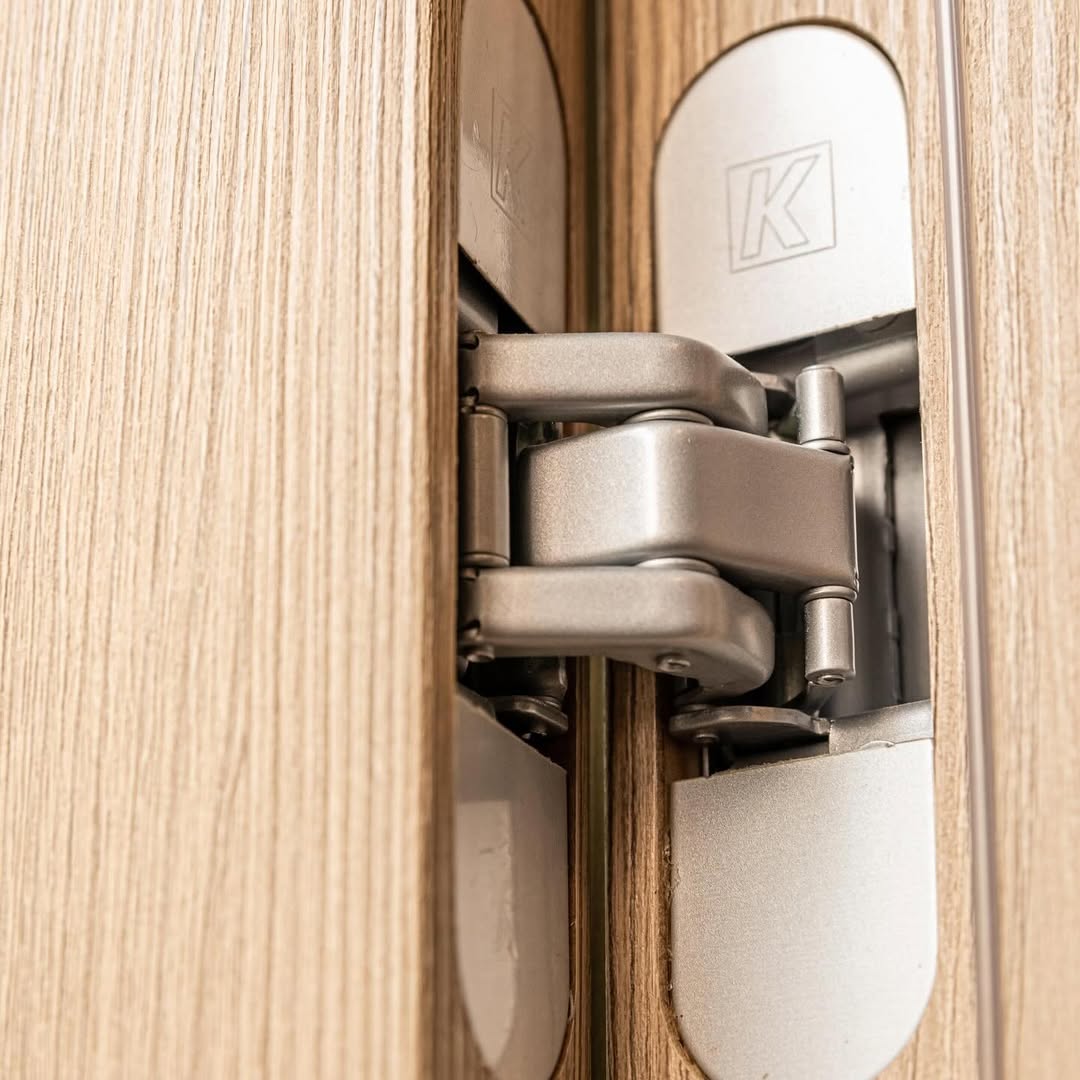
Concealed hinges preserve the clean relationship between the white slab and black perimeter because they are not visible when the door is closed. They are especially suitable for modern flat-panel doors and visually restrained openings.
Visible hinges can also work, but their finish should relate to the frame, handle, or another established metal finish. A bright hinge beside a matte-black frame may become an unintended focal point.
Hinge selection is not purely decorative. Door weight, dimensions, swing direction, frame construction, adjustment requirements, and manufacturer compatibility remain more important than color.
Do not paint hinge knuckles or other operating components without approval from the manufacturer or installer. Added paint can affect movement, clearances, and long-term appearance.
ITALdoors interior packages may include concealed hinges and magnetic locks, which can help maintain a cleaner composition when the goal is to emphasize the frame rather than the hardware.
Should the handle match the frame?
The handle can match the frame, but it does not have to.
Three practical directions are:
- Matte black: Creates the most unified and graphic result.
- Satin chrome: Produces a cooler, lighter modern appearance.
- Satin brass: Adds warmth to transitional and material-rich interiors.
The handle finish should connect with other elements in the room, such as lighting, cabinetry hardware, plumbing fixtures, furniture details, or window hardware.
The most successful combination is not necessarily the one with the most matching finishes. It is the one in which every finish has a defined role.
When the combination works – and when it does not
White doors with black frames work best when the contrast is repeated selectively, the openings are proportionally consistent, and the specification covers every visible part of the assembly.
Conditions that support the look
The combination is more likely to feel integrated when:
- Black already appears elsewhere in the room.
- Door openings have clean, consistent proportions.
- Frame and casing widths remain uniform.
- Door and wall whites have compatible undertones.
- Finish sheen is selected deliberately.
- Lighting reveals the contrast without excessive glare.
- Baseboard transitions are resolved before installation.
- Builders and installers receive one coordinated finish schedule.
Sampling is particularly important. A cool white door can look noticeably blue beside a warm cream wall, while two blacks with different undertones or sheen levels can appear mismatched under natural light.
Review samples vertically and in the actual room whenever possible. A finish evaluated flat on a table may appear different when installed around an opening.
Seven mistakes to avoid
The following errors can make an otherwise strong combination look inconsistent or unfinished:
- Treating frame, jamb, and casing as interchangeable terms.
Identify every surface that should receive the black finish. - Choosing unrelated black finishes.
A blue-black frame, warm-black handle, and glossy black window may not read as one family. - Skipping white-undertone testing.
Compare the door finish with the wall paint, ceiling, cabinetry, and nearby trim. - Painting only the front-facing casing.
Visible jambs, stops, edges, and returns must be considered. - Making every baseboard black automatically.
Evaluate the effect across the complete floor plan rather than one doorway. - Mixing sheen levels unintentionally.
Matte, satin, and gloss finishes reflect light differently and should be chosen deliberately. - Ordering the slab before confirming the full assembly.
Verify the frame type, wall thickness, opening direction, hardware, casing, rough opening, and installation conditions first.
Readers who decide that a white-and-black combination is too graphic for their interior can explore a wider range of alternatives in ITALdoors’ guide to 20 interior door colors and coordinated design ideas.
Specifying a complete white-door and black-frame system with ITALdoors
A successful specification begins with the opening and door system, not with the paint color. The same white-and-black concept may require different components for a swing door, pocket door, wall-mounted slider, concealed system, or custom opening.
Start with the slab, opening type, and wall condition
Before choosing a frame finish, confirm the complete project requirements:
- Door model and slab design
- Approved white finish
- Opening configuration
- Rough-opening dimensions
- Finished wall thickness
- Frame and casing type
- Black finish and sheen
- Hinge type
- Lock and handle selection
- Baseboard transition
- Door swing and handing
- Quantity and room schedule
- Installation responsibility
- Required delivery sequence
ITALdoors offers modern, transitional, flat-panel, swing, pocket, sliding, bypass, frameless, concealed, and custom door solutions for different residential and commercial applications. Matte White is among the listed interior finish options, although model compatibility and current availability should always be confirmed.
For renovations, existing wall conditions may restrict the frame type or casing depth. For new construction, involving the door supplier earlier can make it easier to coordinate openings, wall thicknesses, concealed systems, and transitions before drywall and finish work are completed.
Evaluating a dark-frame solution
A dark aluminum or black-profile solution should not be specified from an inspiration image alone. The exact product name, frame construction, finish method, compatible door models, wall requirements, installation sequence, package contents, and current availability must be verified for the project.
Until those details are confirmed, homeowners and professionals should describe the goal as a coordinated white-door and dark-frame system rather than assuming that a particular visible aluminum frame kit will work with every ITALdoors model.
An ITALdoors product specialist can help evaluate whether the intended appearance is better achieved through black casing, a finished jamb, a visible frame profile, a concealed-frame reveal, or another compatible system.
Why the complete package matters
A door slab can look correct in isolation and still fail as an installed assembly if the frame, casing, hinges, lock, and handle were not coordinated.
ITALdoors interior packages may include:
- Door slab
- Frame
- Casing
- Concealed hinges
- Magnetic lock
- Handle
This coordinated approach is especially useful when the project includes multiple openings, repeated unit types, custom dimensions, or specific installation conditions.
Selected interior models may be available from local stock or through quick-ship options, while custom and special-order systems depend on the selected model, dimensions, finish, configuration, and current project requirements. Availability and timelines should be confirmed before the construction schedule is finalized.

Frequently asked questions about White Doors with Black Frames
Do black door frames look good with white doors?
Yes. The combination works particularly well when the frame dimensions are consistent, black appears elsewhere in the room, and the white door coordinates with the wall undertone. The frame creates definition, while the white slab prevents the opening from becoming as visually heavy as a fully black door.
Should black door frames match black window frames?
They can match, but an exact match is not always necessary. The finishes should appear related in undertone and sheen, particularly when the door and window are visible together. Small differences are less noticeable when the elements are separated by distance, materials, or different lighting conditions.
Should baseboards be black with black door frames?
Not necessarily. White baseboards keep the black emphasis around the opening and create a lighter result. Black baseboards produce a stronger, continuous perimeter around the room. Choose them when black trim is already part of the broader architectural concept rather than adding them only because the door frame is black.
Can I paint existing door trim black and leave the door white?
Yes, but the project should include more than the front-facing casing. Review the jamb, door stop, trim edges, caulking lines, hinge finish, surface preparation, and paint compatibility. A neatly painted casing beside an untreated or damaged jamb can make the opening look incomplete.
What wall colors work with white doors and black frames?
Crisp white creates the strongest graphic effect, while warm white and greige soften the contrast. Pale gray, muted green, beige, and other restrained colors can also work. Compare physical samples because the undertone of the door, wall, frame, and flooring can change under natural and artificial light.
What color hinges and handles should I use?
Concealed hinges are often the cleanest choice when compatible with the selected door system. Visible hinges can match the black frame or another established hardware finish. Matte-black handles create a unified look, satin chrome feels cooler and lighter, and satin brass adds controlled warmth.
Do black frames make small rooms look smaller?
A narrow black frame usually has less visual weight than a fully black door. It can define the opening without darkening the entire surface. However, combining black frames with black baseboards, dark window trim, and several other continuous black lines can make a small room feel more enclosed.