Invisible interior doors
What is an invisible (flush-to-wall) door?
Invisible doors, often called flush-to-wall doors, represent the purest expression of minimalist architecture. When closed, they are designed to read as part of the wall, not as a separate object. Achieving this effect requires very specific construction.
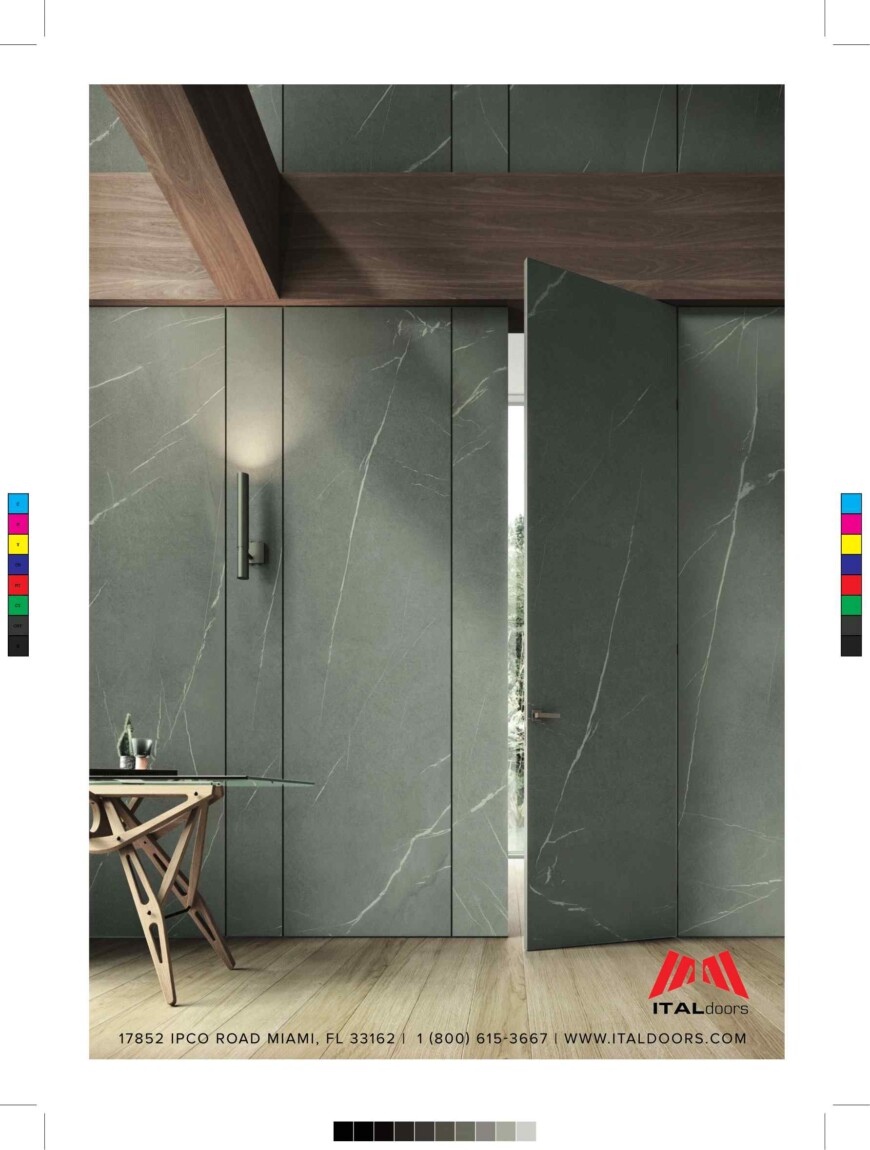
In an invisible system, the door leaf aligns almost perfectly with the plane of the wall. The frame is either entirely concealed or reduced to a thin, paintable profile that merges with the surrounding surface. Traditional casings, with their protruding trims and decorative edges, are eliminated. The result is a surface where the only visible clues to a doorway might be a fine shadow line and a handle.
It is useful to distinguish between:
- Invisible or flush-to-wall doors – where the frame is hidden or blended into the wall, and the door panel is coplanar with the wall surface.
- Standard framed doors – where the frame and casings are intentionally visible, creating a clear visual border between wall and opening.
While the term “frameless” is sometimes used casually to describe invisible doors, technically the frame still exists; it is simply concealed. ITALdoors works with these engineered frames to ensure structural stability and precise alignment even when the visual goal is to make the door “disappear.”
Why invisible doors are trending in 2026
Invisible doors address several desires that define contemporary living: calmness, visual continuity and a sense of tailored refinement. They have grown in popularity because they solve multiple design challenges at once.
In living rooms and open-plan spaces, invisible doors allow long walls to remain uninterrupted. Storage rooms, secondary bathrooms or utility closets can be accessed when needed but do not visually announce themselves. Hallways, often cluttered by multiple door frames, become serene passages where a single artwork or light fixture can be the focal point instead of a line of openings.
Invisible doors are particularly well suited to:
- Minimalist interiors where every visible element is carefully curated.
- Spaces with integrated wall paneling, built-ins or architectural millwork.
- Homes where visual calm is a priority, for example in wellness-oriented or spa-like environments.
They also serve a very practical purpose. A concealed door to a small bathroom off the living room, a hidden storage room behind the kitchen or a discreet access to a laundry area can significantly elevate the perceived quality of a home. Instead of announcing service rooms, the architecture gently hides them.
Invisible doors and wall paneling / wallpaper integration
One of the most compelling uses of invisible doors is their integration with wall paneling and wallpaper. When executed properly, the door becomes part of a larger composition, and its presence is revealed only when it opens.
ITALdoors specialty doors include frameless solutions that can be coordinated with wall panels or finished to accept wallpapers and decorative treatments. This opens a wide range of possibilities:
- A secret library door disguised as a continuous bookcase panel.
- A concealed pantry entrance hidden within a series of kitchen wall panels.
- A hidden home office behind what appears to be a simple bedroom wall.
A guest bathroom door that shares the same wallpaper pattern as the surrounding surfaces, preserving the integrity of a feature wall.
The key is that the door is planned as part of the wall design from the outset, not added later. Panel lines, grooves, textures or wallpaper patterns are aligned across the opening. Hardware choices support the illusion, often relying on minimal or color-matched handles that do not disrupt the surface.
This level of integration is where Italian craftsmanship shows its value. Precision in manufacturing and alignment, combined with a deep understanding of finishes, allows ITALdoors systems to merge with paneling and wall treatments without compromising functionality.
ITALdoors supports both homeowners and industry professionals through this process. For homeowners, the team explains what level of preparation is needed, how invisible doors will interact with existing or new walls, and what to expect during installation. For architects, designers and builders, ITALdoors provides specifications, technical guidance and a clear understanding of lead times, so invisible doors can be integrated into the broader construction schedule.

Frameless interior doors – lightness, glass and pure geometry
What are frameless interior doors?
Where invisible doors aim to merge completely with the wall, frameless doors pursue a different kind of purity. They are designed to look as though the door leaf is floating within the opening, supported by as little visible structure as possible. The result is a composition based on light, proportion and geometry rather than on frames and trim.
It is important to distinguish between two main families:
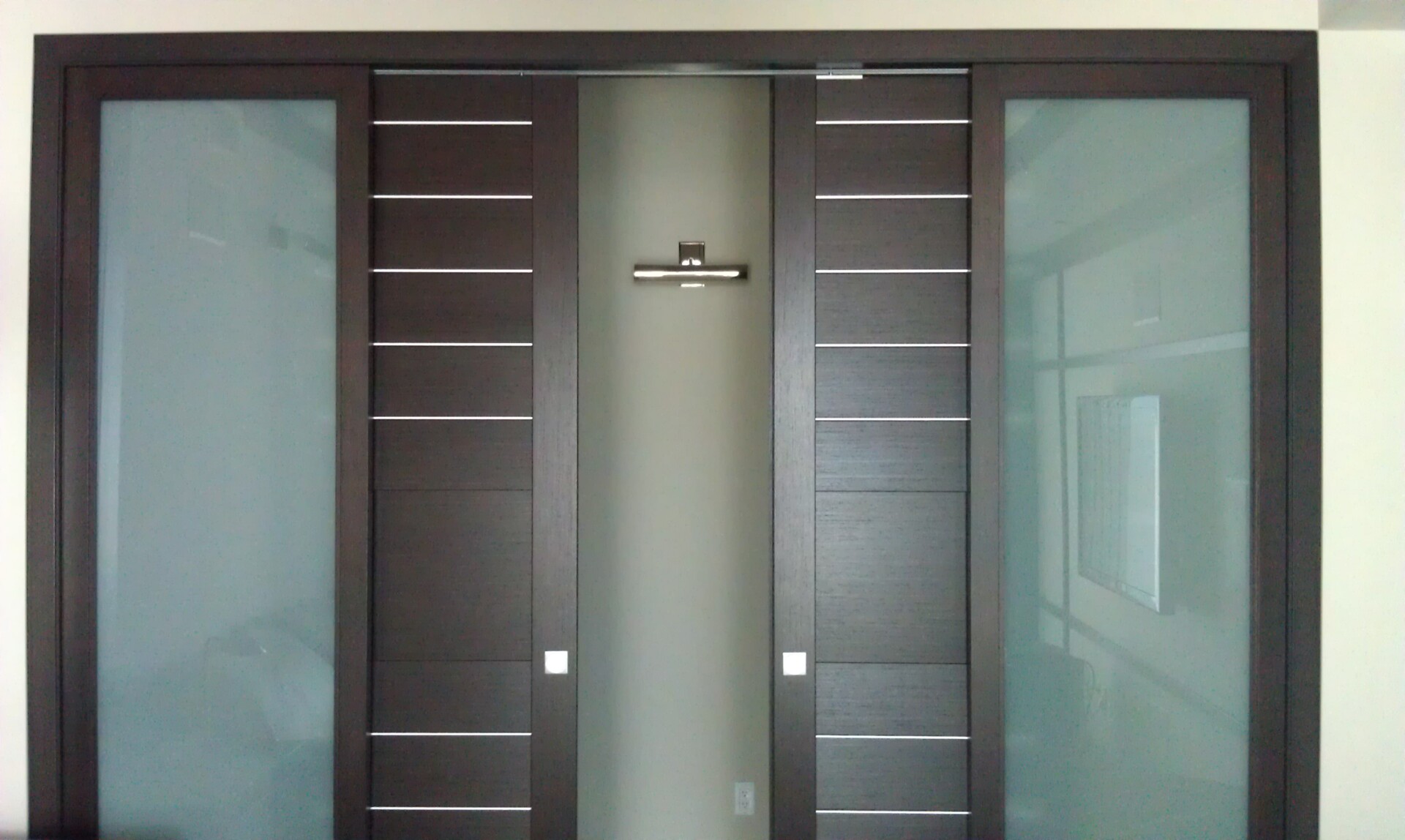
- Frameless glass doors – Typically made of a single sheet of tempered or laminated glass with minimal hardware. The frame is reduced to nearly invisible channels in the floor, ceiling or wall, or to slim profiles that visually disappear. Hinges, pivots or rail systems are integrated so that the glass, not the metal, is what the eye reads.
- Minimal-frame solid doors – These doors are not literally frameless, but the frames are so thin and refined that they recede into the background. The panel can be wood veneer, lacquer or other solid material, with the frame acting as a precise, almost graphic outline rather than a heavy border.
In both cases, the design goal is the same: reduce the visible construction around the door so that the leaf itself – its material, proportions and transparency – becomes the focus. The sense of lightness is not only physical but also visual. The opening feels less like a “hole in a wall” and more like a deliberate, sculpted passage from one space to another.
Frameless designs play a crucial role in modern office and residential projects. In offices, they maintain sightlines across corridors and meeting rooms, supporting transparent work cultures while still controlling noise when combined with the right glass and seals. In homes, they allow living areas, kitchens and studies to remain visually connected, which is especially valuable in compact floor plans and multi-family developments.
Glass, light and visual openness
Glass has become one of the defining materials of contemporary interior architecture, and frameless doors are one of the most effective ways to introduce it. Unlike traditional glazed doors with thick mullions and heavy frames, frameless glass doors capture light in its purest form.
A frameless glass door can:
- Share natural light from a windowed room with a darker hallway or interior office.
- Preserve visual connections between spaces while still allowing them to be acoustically separated.
- Give smaller apartments or townhomes a sense of depth and openness, making partitions feel less like barriers and more like transitions.
Privacy, of course, remains a concern. Modern glass doors address this with a variety of treatments: clear glass for full visibility, frosted or acid-etched glass for blurred silhouettes, or patterned glass that diffuses light while obscuring details. In a home office, for example, a frosted frameless door can signal “occupied” while avoiding the closed-off feeling of a solid door. In bathrooms or en-suite transitions, carefully chosen translucency levels maintain comfort without sacrificing the light.
Applications are broad:
- Home offices benefit from frameless glass when focus and communication are both priorities. A closed glass door softens noise but keeps the person at their desk visually connected to family life.
- Corridors and entry halls gain a sense of flow when doors do not visually “stop” the eye. A sequence of frameless glazed openings can turn a narrow hallway into a gallery-like passage.
- Small apartments use frameless glass to separate sleeping areas from living spaces, preserving privacy at night while keeping the overall footprint bright during the day.
- Multi-family projects and commercial spaces often rely on frameless systems to create consistent, upscale circulation areas with a sense of transparency and security.
By combining the structural reliability of Italian engineering with minimal hardware and precise installation, ITALdoors can help designers use glass not as an add-on, but as a core architectural material.
When to choose frameless instead of invisible
Invisible and frameless doors serve different purposes and suit different design intentions, even though both arise from a minimalist mindset.
Invisible doors are ideal when the goal is to make an opening disappear into the wall. Frameless doors are the right choice when you intentionally want the door to be visible, but light, minimal and sophisticated. The decision often comes down to whether the door should act as a subtle feature or as a “non-element” in the room.
Frameless solutions make sense when:
- You want to show the material – glass, a special wood veneer or a refined lacquer – as part of the design story.
- You need visual transparency, for example between a kitchen and dining area or between a corridor and a study.
- The door should signal a transition in a gentle way, using proportion and material rather than heavy frames or decorative trim.
Stylistically, frameless doors pair beautifully with:
- Metal accents such as slim black, bronze or stainless-steel details found in lighting, furniture or kitchen hardware.
- Contemporary kitchens with flat-panel cabinetry, where a frameless glass or minimal solid door can echo the clean lines of cabinetry fronts.
- Modern bathrooms that combine stone, large-format tiles and glass, creating spa-like enclosures with minimal hardware.
Because ITALdoors offers a broad range of modern door collections, frameless glass or minimal-frame solid doors can be combined with other models in the same project.

Pivot doors and statement openings – bold minimalism for 2026
What is a pivot door and how it works
Pivot doors embody a very specific kind of drama. Instead of hanging on side hinges attached to the frame, a pivot door rotates on a vertical axis supported by pivot hardware mounted in the floor and ceiling (or concealed within the frame system). This allows the door to swing open in a way that feels more like a rotation than a simple swing.
Technically, the pivot point can be located at or near the edge of the door, or set inwards from the edge, creating a balance between the portion of the door that opens into each adjacent space. This flexibility supports very large leaves, including extra-wide and extra-tall panels that would be extremely difficult to manage with conventional hinges.
The impact on space is immediate:
- Openings can be wider and taller, transforming a simple passage into a large, sculptural portal.
- The motion of the door becomes a visual event, with the leaf rotating gracefully rather than swinging in a rigid arc.
- Because the hardware is largely concealed in the floor and ceiling, the composition reads as a large, pure slab of material floating in the opening.
In interior projects, pivot doors often mark thresholds between public and private zones, between entry areas and living spaces, or between a main suite and the rest of the home. Their size and movement signal importance while remaining consistent with minimalist aesthetics when finished with simple hardware and refined surfaces.
Why pivot doors fit the 2026 trend of “bold minimalism”
The design language emerging in 2026 could be described as “bold minimalism”: not busy or ornate, but unafraid of strong gestures. Pivot doors are a perfect expression of this approach.
They combine:
- Strong vertical lines – tall, clean profiles that emphasize the height and volume of a space.
- Minimal visible hardware – slim pulls or recessed handles that do not interrupt the clarity of the panel.
- Monolithic surfaces – uninterrupted wood, lacquer or other finishes that read as architectural elements rather than decorative panels.
Instead of adding complexity, a pivot door introduces a single, decisive gesture. A wide pivot at the entrance to a living room can replace multiple smaller doors and openings. A tall pivot door in a hallway can visually anchor the entire circulation path. In master suites, a pivot door between the bedroom and bathroom or dressing area creates a sense of ceremony every time it moves.
This is why pivot doors are so often chosen for:
- Entryway transitions from foyer to main living space.
- Living room dividers that occasionally separate a media room or study without blocking light.
- Master suites where a generous opening reinforces the sense of a private retreat.
- High-end offices or showrooms where doors are expected to make an immediate impression.
Because pivot systems can handle larger dimensions than typical hinged doors, they also offer practical advantages for moving furniture and large items, all while preserving the simplicity of a single panel.
ITALdoors works closely with architects, designers and builders to coordinate these doors within the overall design and schedule. For homeowners, the team explains what structural and technical provisions are required, so the pivot door can perform reliably while delivering the intended design impact.