Construction & Core: How the Door Is Built (and Why It Matters)
Why construction should be your first filter
Every decision downstream-acoustics, feel in the hand, long-term stability, even finish quality-depends on what sits inside the slab. Modern Interior Doors emphasize sleek surfaces and tight reveals; that minimalism exposes flaws. A door that warps, telegraphs imperfections, or sounds hollow will undermine the entire design.
Solid core vs. hollow core: what changes in real life
- Weight & feel: Solid core interior doors are heavier and feel substantial when opened or closed. The swing is smoother, the close is quieter, and the overall impression is premium. Hollow core doors feel light, drum-like, and can rattle at the latch.
- Durability & repairability: Solid cores better resist impact dents and edge crush, and localized repairs are more predictable. Hollow cores often deform, and punctures are harder to patch invisibly.
- Acoustic benefit: Mass is the first ingredient of sound control. A solid core paired with proper seals typically delivers a meaningful reduction in noise transmission compared to hollow core.
- When hollow makes sense: Utility rooms or strictly budget-driven spaces-providing you accept the trade-offs in sound, feel, and lifespan.
Engineered construction: stability without the guesswork
For modern, tight-tolerance installs, engineered construction is the standard. A typical high-quality build uses:
- Perimeter frame in softwood (often pine): Provides a stable structure for hardware mortising, keeps edges fastener-friendly, and manages seasonal movement.
- MDF or engineered panel faces: MDF offers a smooth substrate for lacquer or veneer, minimizing grain telegraphing and facilitating crisp edges at reveals.
- Engineered cores with foam or composite inserts (e.g., XPS in panel sections): Improve dimensional stability and add sound dampening without excessive weight. XPS also helps resist moisture-related deformation under normal, conditioned interiors.
This combination resists warping and twisting when the building is kept within recommended temperature and humidity ranges-critical for full-height slabs and flush systems.
Acoustic Performance (STC): How Quiet Is the Room?
Understanding STC Without the Jargon
Sound Transmission Class (STC) provides a simplified way to understand how effectively a complete door assembly – including the slab, frame, seals, latch, and threshold – limits noise travel between spaces. The higher the STC number, the better the isolation. Although many homeowners focus only on the slab, the gaps around the door usually determine real-world performance. A high-quality solid door can underperform if installed in a poorly sealed frame, while a precisely engineered system with drop seals and gasket compression can achieve impressive noise control even with a slimmer profile.
In everyday terms, the difference is noticeable. A hollow-core assembly typically performs in the mid-20s, meaning conversations, TV, and movement easily transfer between rooms. A solid-core engineered assembly with compression seals and a proper latch will often reach the low-to-mid 30s – enough to give bedrooms, nurseries, and home offices a comfortable level of privacy. For clients who expect exceptional quiet, enhanced acoustic packages can deliver even more, making rooms feel genuinely separated from household noise.
What Actually Improves Acoustic Comfort
The most important contributor is mass – simply put, heavier and thicker doors outperform lightweight ones. Yet mass alone is insufficient if sound leaks around the perimeter. Proper sealing is essential, particularly at the bottom of the door, where sound freely passes unless a threshold or automatic drop seal is included. Even the latch system plays a role: magnetic latches draw the slab into consistent contact with seals, reducing micro-gaps that mechanical latches may leave.
Another critical factor is how the frame interfaces with the wall. Without proper foam sealing or acoustic caulk, the wall-to-frame gap becomes a silent passageway for noise. The assembly must function cohesively, which is why reputable manufacturers and installers view the door as an integrated system, not a group of parts.

Hardware & Mechanics: Concealed Hinges, Magnetic Latches, Smooth Operation
The 2025 Look: Invisible Technology, Elevated Experience
Modern Interior Doors increasingly rely on advanced hardware that disappears visually while transforming the act of opening or closing a door into a premium moment. This focus on tactile silence and visual clarity is one of the strongest design signatures of the upcoming decade. Every component – hinges, latches, handles – must reinforce the architecture, not distract from it.
The transition from exposed hardware to fully concealed hinges dramatically changes sightlines, while magnetic latches eliminate the clatter and friction of mechanical engagement. These details are why even a standard-sized door can feel like a high-value design upgrade.
Concealed Hinges: Precision You Don’t See
What defines a luxury hinge is not the look – because it is invisible when closed – but the precision of alignment and the strength to support a large slab without sagging. Concealed hinges typically allow adjustments in three dimensions: up/down, left/right, and in/out. Those micro-corrections are crucial on doors with a flush-to-wall aesthetic where even a 2–3 mm reveal discrepancy is visible.
Premium concealed hinges also support wide opening angles, giving unobstructed flow between spaces and reducing the risk of edge damage. To achieve this over time, the stile structure around the hinge zone must be engineered for screw retention. Pre-mortised factory machining ensures accuracy that is extremely hard to replicate in the field.
Handles, Locks, and Smart-Ready Integration
Interior doors are used dozens of times per day. Handle ergonomics – grip comfort, lever projection, thumb turn placement – greatly influence long-term satisfaction. Finishes such as PVD offer excellent scratch and corrosion resistance while maintaining an elegant appearance over years of contact.
Homes with dedicated offices, rental suites, or secure storage can benefit from smart-enabled hardware that enforces temporary access schedules, remote unlocking, or parental overrides. Battery access and emergency bypass must be considered early so that convenience never compromises safety.
Door System & Layout: Flush-to-Wall, Full-Height, Pivot & Pocket – Which Fits Your Plan?
Why the system choice decides both the look and the experience
Modern Interior Doors are not just slabs and hinges; they are systems that integrate frames, hardware, wall build-ups, and finishes. The system you choose determines how minimalist your reveals can be, how quietly the door operates, how much space the swing consumes, and how well the assembly controls sound and light. Choosing the right system early prevents redesigns later, especially when framing, electrical rough-ins, flooring transitions, and baseboard details must be coordinated.
Flush-to-wall (frameless) doors: minimalist lines by design
What “flush” really means
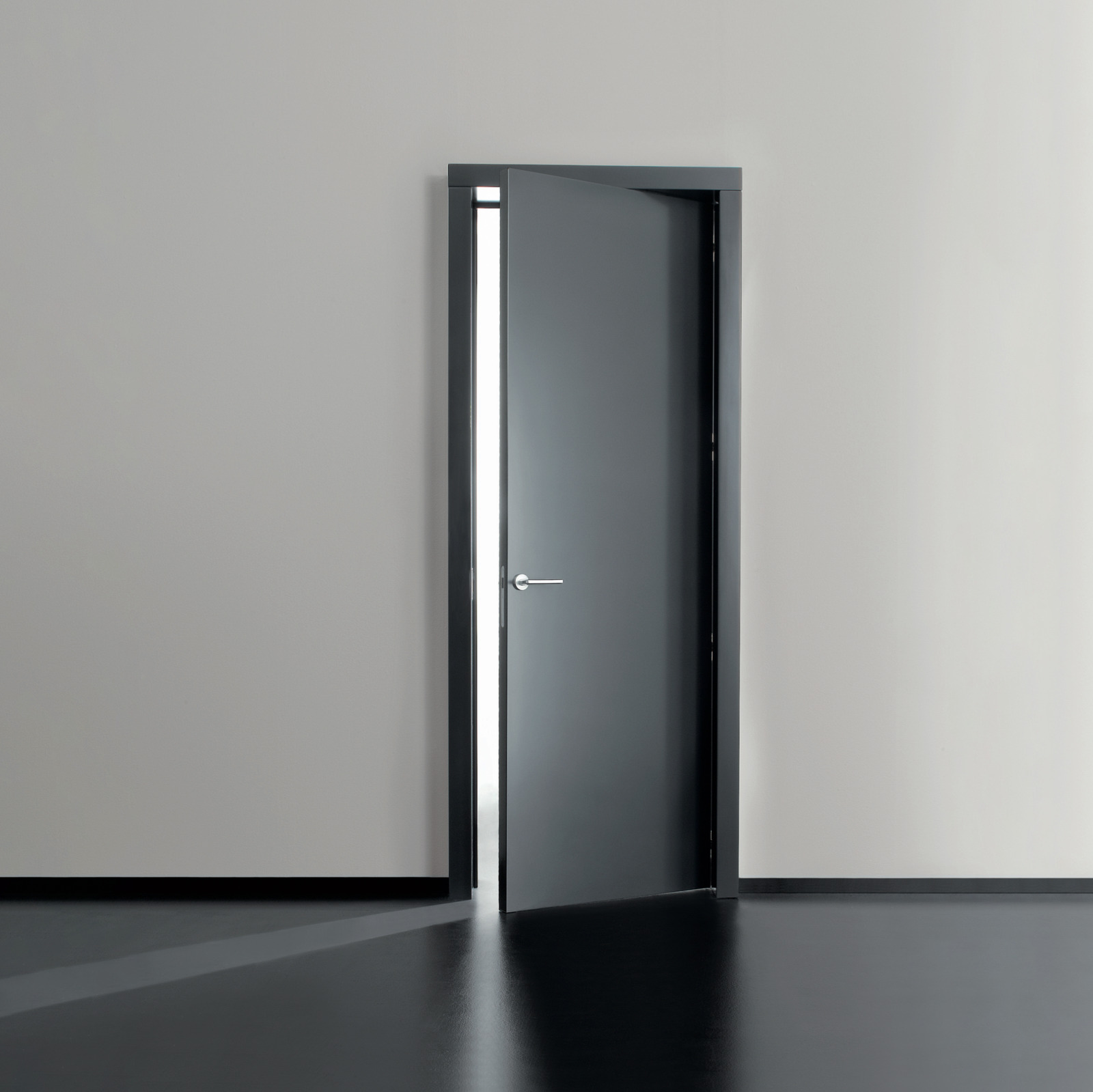
A true flush-to-wall system hides the frame in the wall so the finished plane of the door aligns with the finished plane of the wall. When closed, you see an uninterrupted surface with a fine shadow gap-no protruding casings, no exposed hinges, and often a color-matched panel that disappears into the architecture.
The hidden components that make it work
- Concealed frame: An aluminum or steel “invisible” frame set during rough-in becomes the substrate for plaster or drywall, creating a crisp, shadow-gap perimeter.
- Concealed hinges and magnetic latch: These maintain the clean look and enable precise 3D tuning to keep the reveal razor-even.
- Finish-ready slab: Typically MDF-faced over engineered stiles/rails for flatness; can be painted the wall color or finished as a contrasting panel.
Detailing for success
- Wall build-up: Confirm whether the system is designed for drywall or plaster and match board thickness/screed depth so the finished planes align perfectly.
- Baseboards: Decide whether to recess baseboards for a continuous shadow line or to terminate them cleanly into the concealed frame.
- Electrical coordination: Keep switches, outlets, and thermostats clear of the hinge pocket and latch zone to avoid interference with concealed hardware.
- Humidity and acclimation: Because even small warps are visible on flush doors, acclimate slabs in conditioned interiors and maintain stable humidity during finishing
Acoustic note
Flush systems can be very quiet if paired with perimeter gaskets and an automatic drop seal. The flat, even pull from a magnetic latch helps compress seals consistently along the closing edge.

Full-height doors: vertical emphasis and spaciousness
The aesthetic effect
Full-height Modern Interior Doors visually elongate walls and make ceilings appear higher. They erase the horizontal “head jamb” line, producing a gallery-like calm that suits contemporary interiors.
Engineering considerations
- Slab stiffness: Taller doors need more torsional rigidity. Spec thicker slabs (often 1-3/4 in) and reinforced edges to resist bowing.
- Hinge count and spacing: Plan three concealed hinges for 7–8 ft doors; add a fourth (or more) for 9–10 ft and heavier constructions. Distribute hinges to control deflection under load.
- Head detail: Decide between a true ceiling-flush head (requires precise framing and finishing) or a minimalist reveal below the ceiling plane to absorb tolerances.
- Handle placement: Fix handle height to ergonomics (commonly around 36 in from finished floor) rather than centering on the slab height, which can look awkward and feel inconsistent across the project.
Practical planning
- Door swing vs. lighting: Full-height slabs can shade more ceiling light when opening; ensure task lighting is not blocked in tight rooms.
- Serviceability: Choose hinge models that allow on-site adjustment; small seasonal movements show immediately on tall doors.
Statement pivots: sculptural movement, structural discipline
What defines a pivot door
Instead of hanging on side hinges, a pivot door rotates on a top and bottom pivot set away from the edge, creating a wide, dramatic leaf that moves with a floating feel. This is a showpiece option for Modern Interior Doors where the opening is wide and the architecture can handle the load.
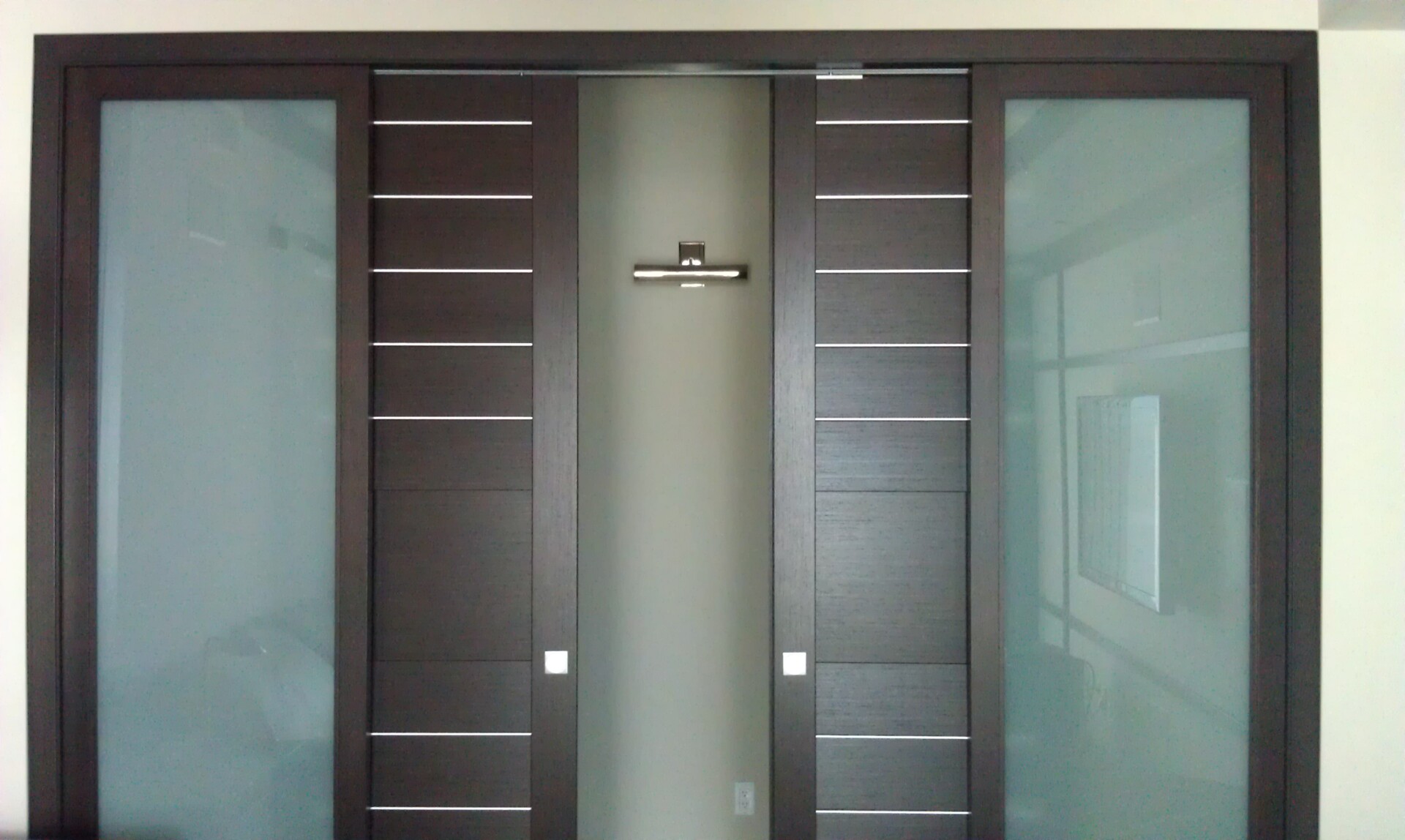
Glazed options: frosted and fluted textures for light and privacy
Why glass belongs in modern interiors
Glazed Modern Interior Doors borrow light from adjacent rooms, making compact floorplans feel generous while maintaining privacy. They also become design elements, adding texture and subtle reflectivity.
Frosted (acid-etched or interlayer) glass
- Privacy without darkness: Frosted surfaces obscure detail while transmitting diffuse light-ideal for ensuites, pantries, and home offices.
- Durability: Factory-etched or laminated frosted glass resists peeling and discoloration better than applied films.
- Maintenance: Specify easy-clean coatings to reduce fingerprints; pair with levers that minimize hand contact on the glass area.
Fluted (reeded/textured) glass
- On-trend texture: Vertical ribs create a refined pattern that breaks up views while letting light pass.
- Optical effects: Fluting softens silhouettes and adds depth; directionality (vertical vs horizontal) can visually elongate or widen a space.
- Safety and acoustics: Choose tempered for safety and laminated where extra sound control is desired.

Comfort & Usability: Widths, Fire Labels, and Everyday Ease
Plan for clearance, safety, and the way spaces are actually used
A beautiful door still has to clear furniture, meet usability goals, and in many projects, accommodate accessibility and fire-safety requirements. The best Modern Interior Doors projects start with code-aware layout choices and finish with hardware that’s comfortable day after day.
Clear opening width: a practical planning baseline
The 32-inch rule of thumb
As a planning guideline for accessibility, target a clear opening of about 32 inches minimum where possible. Remember that clear opening is measured between the door face and stop when the door is open at 90°, not the nominal slab width.
Fire-rated interior doors: when and how to specify
What a fire label means
A fire-rated door assembly is tested to withstand fire for a specific duration (commonly 20 minutes for certain interior locations). The label applies to the assembly-slab, frame, hardware, and glazing-installed as tested. Field modifications, trimming beyond allowed amounts, or non-listed hardware can void the rating.
Typical residential and light-commercial scenarios
- Garage-to-house entries in many jurisdictions require a rated/self-closing assembly.
- Common corridors in multifamily or mixed-use buildings often require labeled doors with self-closing and latching hardware.
- Glazing limits: Fire-rated glazing must be listed and often has area limits; ordinary tempered glass is not a substitute.
Swing direction, hardware heights, and latch requirements
Choosing swing direction
- Into smaller rooms: An outswing door can save interior floor space and keep clearances around fixtures.
- Circulation zones: Inswing from corridors reduces the chance of doors projecting into egress paths.
- View and privacy: Position the hinge side so the door shields sightlines to beds, vanities, or work areas when opened.
Hardware height and ease of use
- Lever height: A consistent ~36 in from finished floor is comfortable in most homes and aligns with common standards.
- No tight grasp/pinch/twist: Levers beat knobs for accessibility and convenience, especially for children and seniors.
- Backset and hand feel: A 2-3/4 in backset can improve knuckle clearance on thicker casings or for larger hands; keep a sample on site for the client to try.
Thresholds and sweeps: balancing comfort with accessibility
When to use them
- Draft, smoke, and odor control: Thresholds with automatic drop seals improve performance in laundry rooms, powder rooms, and bedrooms off busy living spaces.
- Acoustics: A drop seal is often the single most effective upgrade for sound control at the sill.
Keeping passage safe and smooth
- Barrier-free interiors: Favor low-profile thresholds or surface-flush transitions to avoid trip hazards and ease rolling loads.
- Wet areas: Where water can escape (showers, utility rooms), a modest threshold contains moisture while still meeting mobility goals-coordinate slopes and finishes.

Materials, Emissions & Sustainability: Low-VOC Finishes, E1 Formaldehyde, FSC
Why material health matters in modern interiors
Doors cover substantial surface area and are touched constantly. Finishes, adhesives, and core materials influence indoor air quality, occupant comfort, and long-term durability. Modern Interior Doors that combine verified low emissions, responsibly sourced wood, and robust finish systems deliver a noticeable difference in daily life.
E1 formaldehyde class: the practical benchmark to request
What E1 signifies
Under widely accepted European panel standards, E1 indicates a formaldehyde emission limit of ≤ 0.124 mg/m³ (tested under defined conditions). Specifying E1-or better-helps ensure that MDF, particleboard, and plywood used in door cores, skins, and jambs contribute minimally to indoor air pollution when used as intended.
How to verify
Ask for material declarations or test reports indicating the emission class for panels and adhesives used in the door and frame. Ensure the documentation corresponds to the specific product line and not a generic brochure.
Industry baselines and what they mean for you
Many European panel manufacturers have produced at or below E1 levels for years, making it a practical baseline for high-quality Modern Interior Doors. Treat E1 as the starting point, not an upgrade; if your project has heightened sensitivities (nurseries, medical spaces, home studios), consider even stricter options where available.
FSC-certified wood: chain-of-custody and real-world benefits
What to look for
- FSC 100%: All wood from responsibly managed forests.
- FSC Mix: Blend of FSC-certified and controlled sources.
- FSC Recycled: Wood from verified recycled content.
Why it matters
FSC certification links the product to a traceable chain-of-custody, which supports responsible forestry, reduces the risk of illegal logging, and reassures clients who value sustainability. For multifamily and commercial projects, verifiable sourcing can also contribute to owner ESG goals and certain building program checklists.
Child Safety, Controlled Privacy, and Peace of Mind
Why smart functionality matters for real family life
Modern Interior Doors increasingly play a role not only in aesthetics but also in household safety and controlled access. In families with young children or multigenerational living situations, the right smart hardware can shape behavior, prevent accidents, and provide peace of mind without adding visual clutter or daily inconvenience. Smart access isn’t about turning a home into a fortress – it’s about subtle improvements that keep the environment safe, intuitive, and supportive of everyone’s needs.
Balancing acoustic comfort with safety
Family homes are full of different schedules – early sleepers, remote workers, teens studying late. That means sound isolation matters. Modern Interior Doors with solid-core construction, perimeter seals, and drop seals block disruptive household noise while still enabling parents to override locks or monitor access digitally.
The result is a healthier balance between:
- Personal space
- Noise reduction
- Child supervision
- Safety and accident prevention
Where this smart approach shines
This configuration is particularly well-suited for:
- Families with babies and toddlers
- Children transitioning into private routines
- Homes with grandparents or caregivers
- Houses where hazardous rooms require controlled entry
- Floor plans with mixed-use areas (office + living + recreation)
- Smart access becomes a natural part of household rhythm – doors help guide safe behavior while maintaining comfort and beauty.